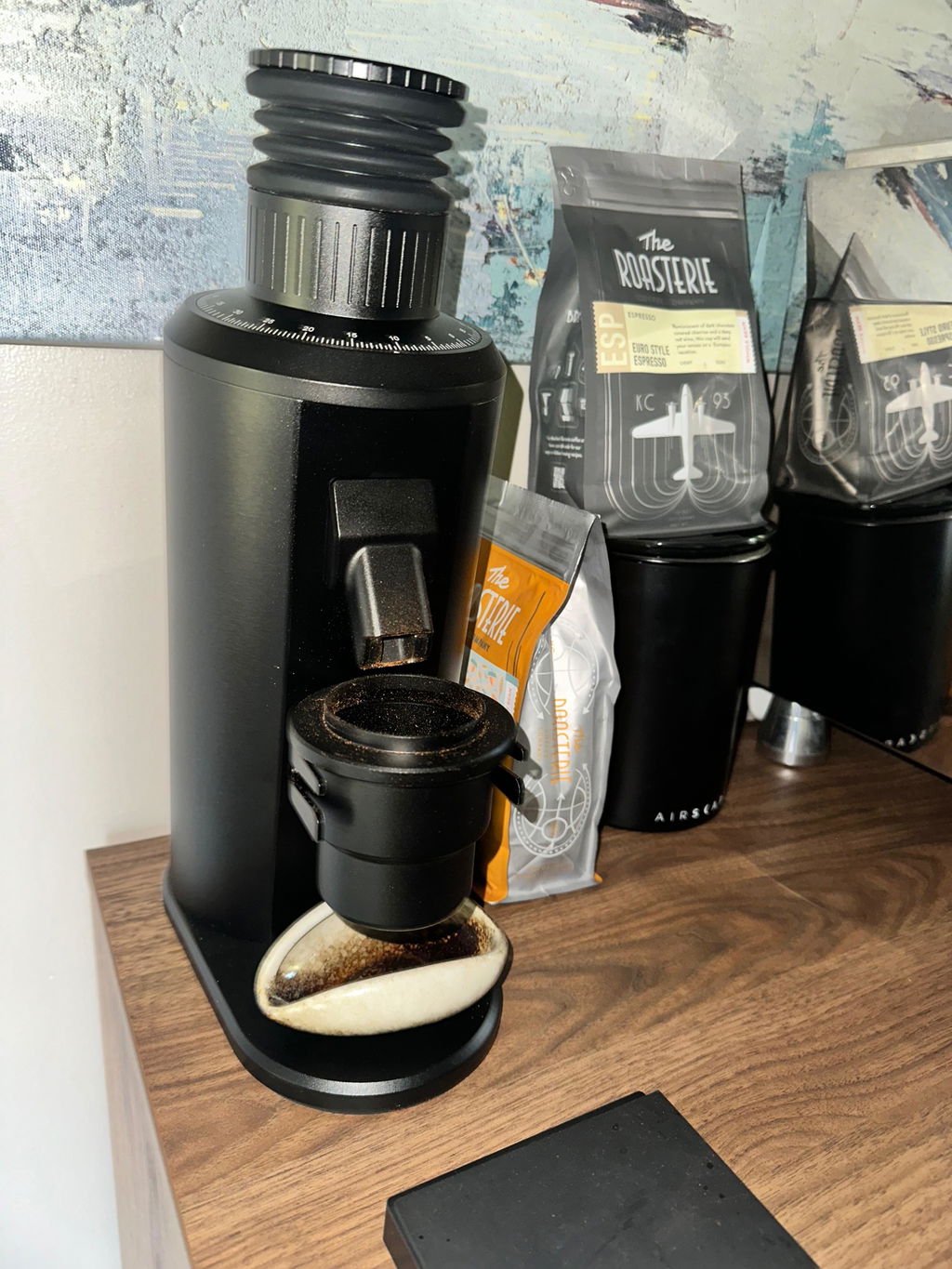
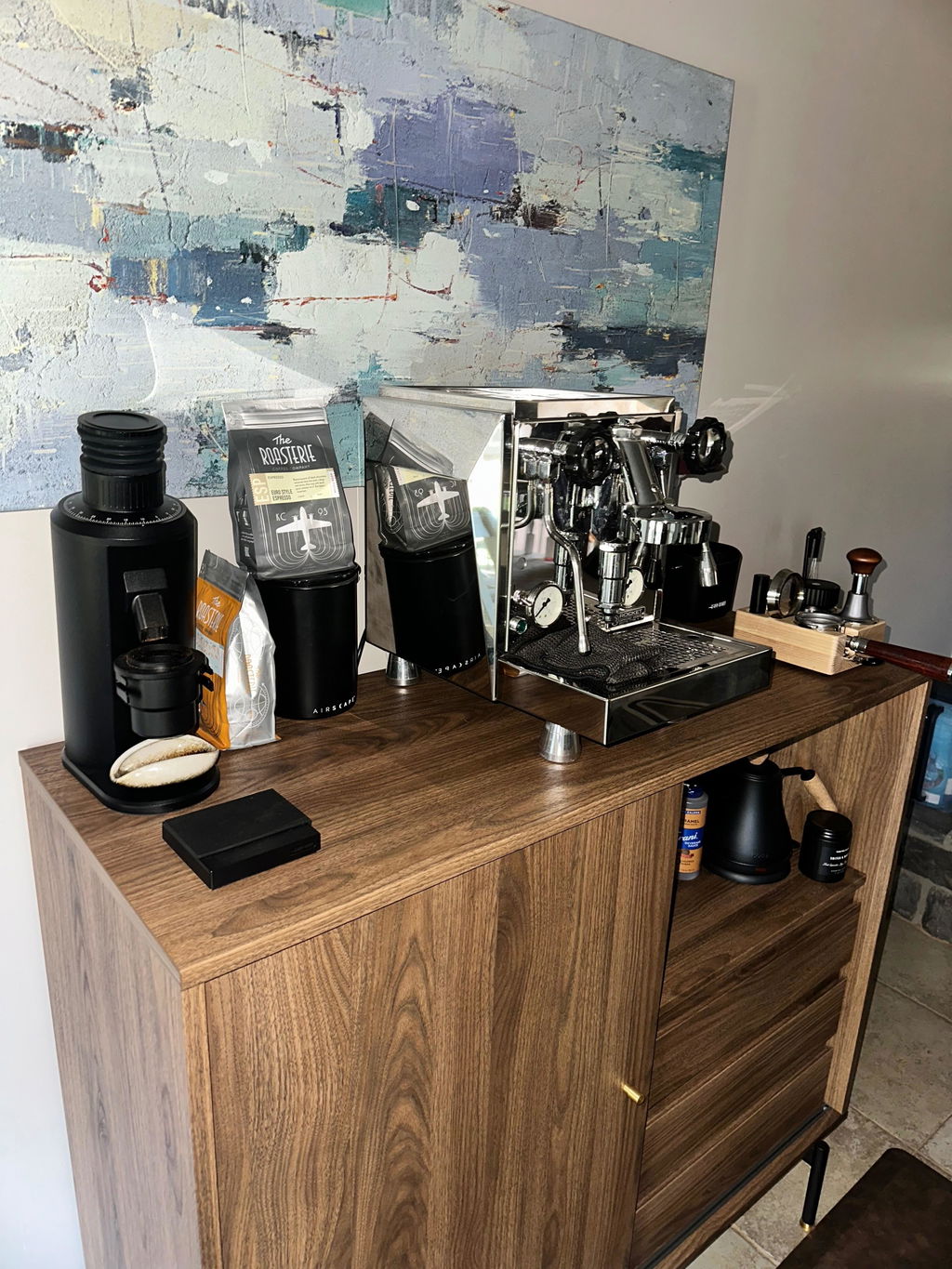
Niche Coffee Grinders: Zero vs Duo, History and Alternatives
Niche Coffee helped make single dosing a mainstream home-coffee workflow. The original Niche Zero combined a short grind path, 63 mm conical burrs, stepless adjustment and unusually simple controls in a compact grinder. The later Niche Duo kept the same basic philosophy but moved to 83 mm flat burrs and a larger chassis.
This guide examines the complete current Niche grinder range, the brand’s development history, Zero-versus-Duo differences, burr choices, realistic retention expectations, grind-setting starting points, cleaning and calibration, direct-purchase considerations, and the closest grinders available from Espresso Outlet.
Editorial disclosure: Espresso Outlet does not sell Niche grinders. We do sell several grinders compared in this guide. Specifications and model availability were checked against Niche’s official information in September 2026; always confirm the selected burr set, voltage, plug and purchase terms before ordering.
Quick answer: which Niche grinder is for whom?
- Choose the Niche Zero if you value an easy, quiet, forgiving single-dose workflow and generally prefer espresso with body, sweetness and blended flavors.
- Choose the Niche Duo with espresso burrs if you specifically want a larger 83 mm flat-burr platform and tend to value flavor separation and clarity.
- Choose the Niche Duo with filter burrs if manual pour-over or batch-style filter coffee is the main job and you want a burr set intended for that range.
- Choose an alternative platform if variable speed, extensive aftermarket burr choices, a bellows-based purge, domestic retailer support or a lower entry price matters more than Niche’s particular workflow.
That is the short version. Burr geometry alone does not determine taste, and neither “flat” nor “conical” automatically means better. Alignment, burr design, coffee, roast level, recipe and extraction all affect the cup.
Niche Coffee history: from prototypes to a single-dose benchmark
Founder and product designer Martin Nicholson began developing the grinder that became the Niche Zero in 2015. Niche’s account says the project grew out of watching family members struggle with a conventional grinder that was loud, inconsistent and prone to holding old grounds. Instead of treating those problems as unrelated inconveniences, Nicholson designed around the complete at-home routine.
The company says more than 30 prototypes were built and tested over roughly three years. Prototypes were taken to cafés and shown to baristas in the United Kingdom, allowing feedback on adjustment, dosing, noise and the physical workflow to shape the production design. Nicholson also brought experience from consumer-product work associated with brands such as Kenwood, Philips and Braun.
The Zero was publicly introduced in 2017 and funded through Indiegogo, with early coverage focusing on its attempt to minimize retained coffee. This timing was important. Serious home grinders were commonly derived from hopper-fed commercial designs. Enthusiasts could single-dose them, but the grinder itself was not necessarily designed for one weighed portion at a time.
Niche instead made single dosing the default: weigh the beans, open the lid, pour them into the angled chamber, close the lid and grind into the supplied cup. The compact body, wood trim and simple switch made the machine feel like a domestic appliance rather than a shortened café grinder. Niche subsequently reported selling more than 100,000 Zero grinders.
The Niche Duo extended the concept into the large flat-burr category. It did not replace the Zero. The two remain meaningfully different products: the Zero centers on a 63 mm conical set, while the Duo centers on interchangeable 83 mm flat-burr sets selected for espresso, filter, or both.
For a separate look at the design process, see our Niche Zero concept and development history.
Complete current Niche grinder lineup
Niche’s current range is unusually small. There are two grinder platforms—not dozens of numbered models. Color, plug and Duo burr selections are configurations rather than separate grinder models.
| Specification | Niche Zero | Niche Duo |
|---|---|---|
| Burrs | 63 mm conical burrs | 83 mm flat burrs |
| Burr choices | One all-purpose conical set | Espresso set, filter set, or both depending on selected package |
| Adjustment | Infinite stepless dial | Infinite stepless dial |
| Published grind speed | Approximately 1 gram per second | Approximately 1 gram per second |
| Published noise | 72 dB | 72 dB |
| Published dose consistency | Less than ±0.2 g in the independent test cited by Niche | Less than ±0.2 g in the independent test cited by Niche |
| Width | 122 mm | 135 mm |
| Depth | 211 mm | 230 mm |
| Height | 311 mm closed; 435 mm with lid open | 355 mm closed; 480 mm with lid open |
| Weight | 4.1 kg / 9 lb | 5 kg / 11 lb |
| Body and trim | Aluminum body, real-oak trim | Aluminum body, real-oak trim |
| Included basics | 58 mm grind cup, socket driver, cleaning brush and manual | Selected burr set(s), 58 mm grind cup, socket driver, cleaning brush and manual |
| Best fit | Simple espresso-first all-round use | Buyers intentionally seeking large flat burrs |
Niche Zero
The Niche Zero is a stepless, single-dose grinder built around 63 mm conical burrs. Its wide collar provides the grind adjustment, and the scale spans espresso through coarse brewing methods. The grinder has no timer, dose-by-weight system, touchscreen or programmable buttons. The user weighs the input dose separately and lets the grinder process the entire portion.
That simplicity is a central part of the appeal. There are few controls to learn, the dosing cup fits a standard 58 mm portafilter, and the short path limits the spaces where grounds can accumulate. Niche lists a grinding rate of about one gram per second, so an 18 g espresso dose takes roughly 18 seconds as a general estimate; bean density and grind setting can change actual time.
The Zero is frequently described as an espresso grinder, but it is not espresso-only. Its adjustment range extends through AeroPress, pour-over and French press territory. The more useful question is whether its conical burr presentation matches your filter-coffee preferences. Many users associate this style with rounder texture and integrated sweetness, while high-clarity filter drinkers may prefer a flat burr designed for stronger flavor separation.
Niche Duo
The Niche Duo is the larger 83 mm flat-burr model. It follows the Zero’s single-dose and stepless-adjustment concept but targets buyers who want the capacity and potential cup character of a large flat set. The chassis is 13 mm wider, 19 mm deeper and 44 mm taller when closed. It also requires 480 mm of vertical clearance with the lid open, an important measurement under wall cabinets.
Niche offers the Duo around espresso and filter burr choices. The espresso burrs are the logical choice for an espresso-led setup and, according to Niche, can still make good filter coffee. The filter set is for buyers prioritizing coarser brewing and the particle distribution intended for that use. A package with both sets gives flexibility, but owning both does not turn a burr change into a one-minute daily switch.
Changing the Duo’s burrs requires opening the grinder, handling precisely machined parts correctly and recalibrating afterward. It makes sense for an occasional change in the grinder’s role, not for moving back and forth every morning. Households that regularly alternate between espresso and filter may find two grinders more convenient than repeated burr swaps.
63 mm conical versus 83 mm flat burrs
Burr diameter is only one design variable, but the Zero and Duo are different enough that taste goals should lead the decision.
| Priority | Likely better starting point | Why |
|---|---|---|
| Full-bodied traditional espresso | Niche Zero | Its conical set is commonly favored for texture, blended sweetness and a forgiving presentation. |
| Clear separation in light-roast espresso | Niche Duo espresso burrs | The large flat platform is aimed at buyers seeking greater definition between flavors. |
| Dedicated pour-over use | Niche Duo filter burrs | The filter set is the purpose-specific choice in Niche’s range. |
| Frequent changes between brew methods | Niche Zero or two dedicated grinders | The Zero spans a broad range without a burr change; switching Duo sets is a maintenance procedure. |
| Simple dialing across medium and darker roasts | Niche Zero | The conical platform is generally the more forgiving choice. |
| Experimentation with burrs and motor speed | Alternative grinder platform | Niche emphasizes a curated, simple system rather than RPM control or a large aftermarket ecosystem. |
These descriptions are tendencies, not guarantees. A well-extracted coffee from either machine can be sweet, clear and balanced. The same grinder can taste very different after a change in burr seasoning, alignment, water, basket, temperature, ratio or flow.
What “zero retention” actually means
The Zero name describes the design objective; it should not be read as a laboratory promise of exactly 0.0 g retained or exchanged in every condition. Three related measurements are often confused:
- Total retention is the coffee remaining inside the grinder after use.
- Exchange is older coffee leaving during the next dose while an approximately equal amount of new coffee stays behind.
- Dose consistency compares input and output weights. Similar weights do not prove that every particle exiting came from the current dose.
Roast level, humidity, static, burr seasoning, grind size and cleaning state all change behavior. Oily dark roasts tend to leave different deposits than dry light roasts. A grinder can also appear weight-consistent while exchanging a small amount of coffee between doses.
For everyday use, the practical strengths are the short pathway and the ability to grind a weighed dose without maintaining a loaded hopper. If exact output matters, weigh both input and output periodically rather than assuming the name settles the question.
Official Niche grind-setting starting points
Niche publishes broad starting ranges for its dial. They are useful for orientation, not universal recipes. Calibration position, bean age, roast, basket, dose and desired flow can shift the correct setting considerably.
| Brew method | Niche Zero starting range | Niche Duo starting range |
|---|---|---|
| Espresso | 5–20 | 0–10 |
| Moka pot | 20–30 | 10–20 |
| AeroPress | 30–35 | 20–30 |
| V60 / pour-over | 35–45 | 30–45 |
| French press | 45+ | 45+ |
How to dial in espresso
- Confirm that the grinder is calibrated according to the correct Niche manual.
- Choose one dose and keep it fixed—for example, whatever your basket is designed to hold.
- Start within the official espresso range and use a repeatable distribution and tamp.
- If the shot runs too quickly, move finer in a small increment. If it chokes or runs too slowly, move coarser.
- Once flow is close, judge taste. Sour or thin espresso may need a finer grind, longer ratio or higher extraction; harsh or drying espresso may need the reverse. Do not use time as the only target.
- Purge only when a setting change or cleaning condition makes it necessary. Excessive purging defeats part of the value of single dosing.
Record the coffee, dose, yield, time and dial position. The number is a repeatable reference for your grinder, not a universal setting for every Zero or Duo.
Switching from espresso to filter
A large move coarser changes the space between the burrs and can release grounds left in the chamber. After changing range, run the grinder briefly and inspect the output before assuming the first dose is perfectly representative. When returning to espresso, approach the target carefully and follow Niche’s adjustment instructions; forcing an adjustment in the wrong condition can stress the mechanism.
Cleaning, calibration and ownership
Low retention does not mean maintenance-free. Coffee fragments and oils still collect around burrs and internal surfaces. Cleaning frequency depends on volume and coffee style, but changes in aroma, clumping, output or adjustment feel are signals to inspect the grinder.
Routine care
- Disconnect power before opening the grinder.
- Follow the model-specific manual; the Zero and Duo are not identical internally.
- Use the supplied brush or another suitable dry brush around burrs and accessible surfaces.
- Keep water away from the motor and burr chamber unless an official instruction specifically says otherwise.
- Do not casually disturb alignment hardware or remove parts unrelated to routine cleaning.
- Reassemble fully and confirm calibration before dialing in again.
Calibration
Calibration gives the dial a meaningful reference point. It does not make a setting number transferable to every grinder. After deep cleaning, burr removal or a Duo burr-set change, use Niche’s current model-specific calibration procedure. Never rely on an old video if its steps conflict with the manual supplied for your production revision.
Burr seasoning
New burrs can change as their sharp manufacturing edges settle through use. Static, speed and cup character may evolve over the first several kilograms. There is no need to waste large quantities of good coffee merely to reach an arbitrary seasoning number; expect some movement, make incremental recipe changes and evaluate the grinder over normal use.
Voltage, plugs, buying and support considerations
Niche primarily sells direct, so buyers should compare the final transaction and ownership path—not just a headline price. The Zero’s official page lists versions for the UK, US, EU, Australia and Japan, with region-specific voltage and plug information. The Duo page lists UK, US, EU and Australian plug choices. Availability can change.
- Order the correct electrical version. A travel adapter changes plug shape; it does not convert voltage or frequency.
- Check landed cost. Shipping, taxes, duties, currency conversion and card fees may affect the total.
- Read the current warranty and return terms. Confirm who pays shipping and where service is performed.
- Verify the Duo burr selection. Do not assume both sets are included unless the selected package explicitly says so.
- Measure overhead clearance. The open-lid heights matter under cabinets.
Best Niche alternatives sold by Espresso Outlet
No alternative is an exact copy. The useful comparison is based on workflow, burr platform, taste goals, price and support.
| If you are considering | Comparable Espresso Outlet grinder | Why compare it | Main difference |
|---|---|---|---|
| Niche Zero | Turin SK40 | Compact, stepless, conical and designed for single dosing | Smaller 40 mm conical burr platform and a lower price tier |
| Niche Zero | Turin DF54 | Affordable low-retention single-dose workflow | 54 mm flat burrs produce a different presentation and platform |
| Niche Zero | Turin DF64 Gen 2 | Popular single-dose all-rounder with broad burr options | 64 mm flat burrs, bellows and ionizer rather than Niche’s conical design |
| Niche Zero or Duo | Turin DF64V | Single dosing plus flat burrs and variable-speed experimentation | 64 mm platform and a more tuning-oriented ownership experience |
| Niche Duo | Turin DF83V | Large 83 mm flat burrs for high-end home use | DF83V adds variable RPM and a different chute, declumper and purge system |
Niche Zero versus Turin SK40
The SK40 is the closest conceptual alternative for a buyer who specifically wants compact conical single dosing and stepless adjustment. The Niche has much larger 63 mm burrs, a polished dosing-cup workflow and a more premium domestic design. The SK40 is attractive when value and a small footprint matter more than matching the Niche’s burr size or materials.
Niche Zero versus Turin DF64 Gen 2
This is less a like-for-like comparison than a choice between philosophies. The Zero offers a curated 63 mm conical system known for ease and body. The DF64 Gen 2 uses 64 mm flat burrs, adds bellows and an ionizer, and participates in a wide aftermarket burr ecosystem. Choose based on cup style and appetite for modification—not because 63 and 64 are numerically close.
Niche Duo versus Turin DF83V
Both occupy the 83 mm flat-burr category, making this the closest platform comparison. The Duo emphasizes straightforward fixed-speed operation and factory-selected espresso or filter burr sets. The DF83V adds variable RPM, giving advanced users another way to explore feed and extraction behavior. Variable speed is useful only if you want to experiment with it; simplicity is a legitimate advantage for the Duo.
Who should not buy a Niche?
A Niche may be the wrong fit if you keep a hopper full for rapid back-to-back drinks, need grind-by-weight dosing, want commercial throughput, require a local dealer relationship, or plan to explore numerous third-party burr geometries. The Duo may also be excessive if you mainly make medium-roast milk drinks and do not value the attributes of a large flat set.
Conversely, the Zero remains compelling for people who want one uncomplicated home grinder, change coffees often and prefer a conical espresso profile. The Duo makes sense when the buyer understands why they want 83 mm flats rather than simply assuming larger burrs guarantee better coffee.
Niche grinder FAQs
What Niche grinder models are currently available?
The current core lineup consists of the Niche Zero and Niche Duo. Colors, plug types and Duo burr packages are configurations, not separate models. Earlier Zero production changes are revisions rather than distinct named grinders.
What is the main difference between the Niche Zero and Duo?
The Zero uses 63 mm conical burrs and is the smaller, more forgiving all-rounder. The Duo uses 83 mm flat burrs and offers espresso and filter burr choices for buyers seeking a different flavor presentation and platform.
Is the Niche Zero actually zero retention?
No grinder is literally guaranteed to retain or exchange 0.0 g in every condition. The Zero is designed for very low retention and consistent single-dose output, but coffee type, static, humidity and cleanliness affect results.
Can the Niche Zero make filter coffee?
Yes. Niche publishes settings for AeroPress, V60 and French press. Whether it is ideal depends on taste: some filter drinkers enjoy its body and sweetness, while others prefer the separation of a filter-oriented flat burr.
Can the Niche Duo espresso burrs grind filter coffee?
Yes. Niche states that its espresso set can also make good filter coffee. The dedicated filter set exists for buyers who prioritize that brewing style and want its purpose-specific burr geometry.
Should I buy both Duo burr sets?
Only if you expect to change the grinder’s primary role and are comfortable with disassembly and recalibration. For frequent daily switching, one versatile set or two dedicated grinders is usually more convenient.
Does either Niche grinder grind by weight?
No. Both are single-dose grinders: weigh the beans before loading, grind the full dose, and optionally verify output on the scale.
Are Niche grinders stepless?
Yes. Both use an infinitely adjustable stepless dial, allowing small changes between marked positions.
How loud are Niche grinders?
Niche publishes 72 dB for both models. Perceived loudness depends on room acoustics, the beans and measurement method, so use that as a manufacturer specification rather than a guarantee for every kitchen.
How fast do they grind?
Niche lists approximately one gram per second for both. Actual throughput varies with coffee and setting.
Will the Niche dosing cup fit my portafilter?
The included cup is listed as 58 mm, which suits many standard commercial-size baskets. Smaller portafilters may require transferring grounds differently or using another accessory.
Can I use a UK or EU Niche in the United States with an adapter?
Do not assume so. A simple adapter does not change voltage. Buy the correct electrical version for the destination and verify the official label before use.
Does a larger burr always make the Duo better than the Zero?
No. Larger burrs can support different geometry and capacity, but “better” depends on taste, alignment, recipe and workflow. Many people may prefer the Zero’s conical cup profile and simplicity.
Is the Niche suitable for a café?
It is fundamentally a home-oriented single-dose design. A café should evaluate duty cycle, speed, service support and operational needs instead of assuming home enthusiast popularity makes it a commercial grinder.
What is the closest Niche Zero alternative at Espresso Outlet?
The Turin SK40 is the closest compact conical concept, while the Turin DF64 Gen 2 is the stronger comparison for buyers open to a 64 mm flat-burr platform.
What is the closest Niche Duo alternative at Espresso Outlet?
The Turin DF83V is the closest 83 mm flat-burr alternative and adds variable RPM.
Final perspective
The Niche Zero earned its reputation by solving a workflow problem, not by piling on features. It remains a strong choice for a quiet, compact and approachable conical single-dose experience. The Duo is a different proposition: a larger flat-burr grinder for buyers who can articulate the cup style or brewing role they want from it.
Compare the final delivered price, electrical version, burr choice, service route and counter clearance. Then choose based on how you actually brew. For locally supported alternatives across several burr sizes and price points, browse Espresso Outlet’s home coffee grinders or contact us for help matching a grinder to your espresso machine and preferred roast.
Sources and further reading
- Niche Zero official specifications
- Niche Duo official specifications and burr options
- Niche’s account of the Zero’s development and sales history
- Official Niche grind-size guide
- Niche guide to conical and flat burrs
- Original Niche Zero crowdfunding campaign
- 2017 Niche Zero launch coverage
Last reviewed and expanded: September 2026.