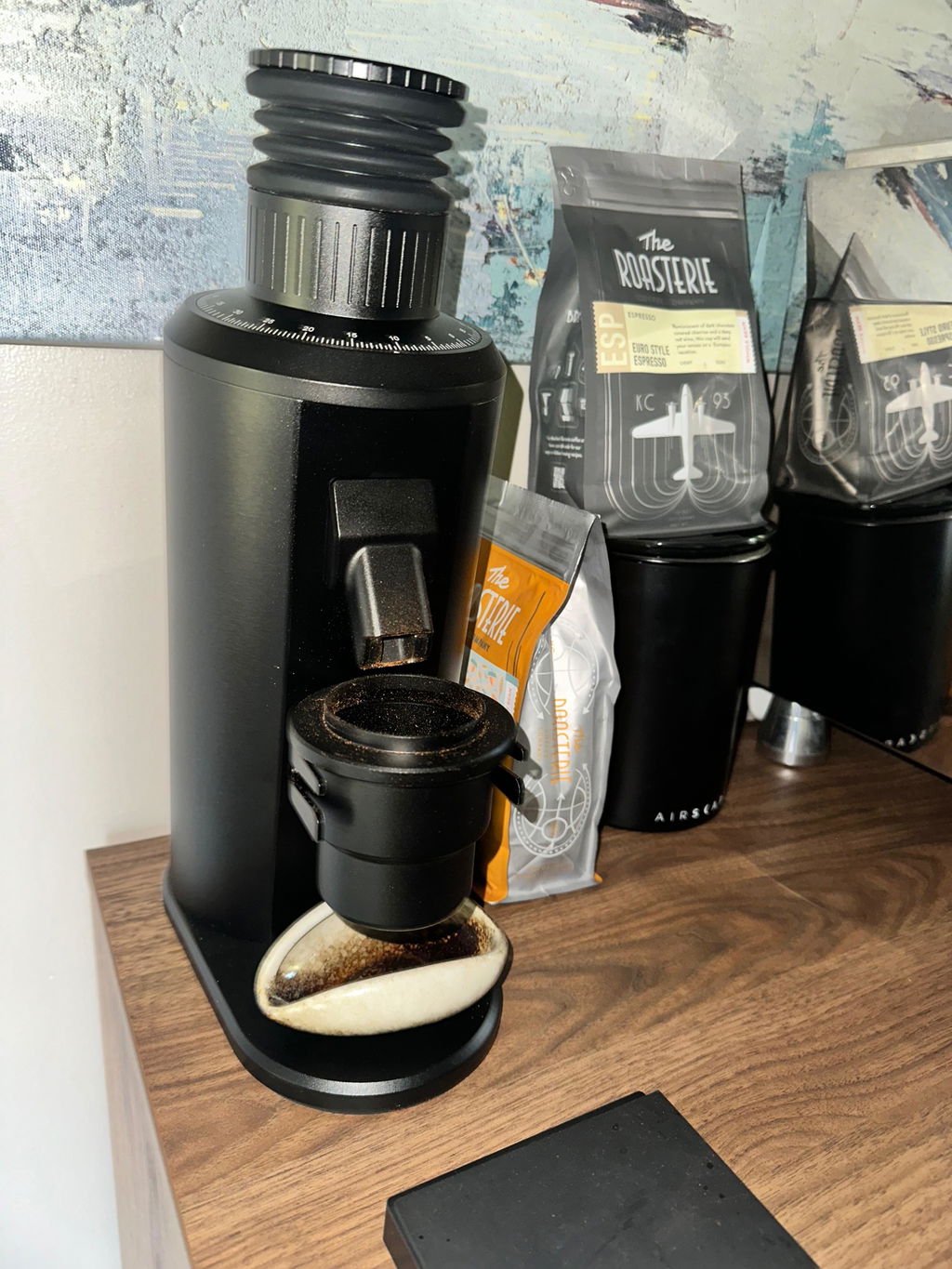
Single Dose Coffee & Espresso Grinders
Precision grinders for your daily coffee ritual.
Choosing your equipment
Single-dose coffee grinders are designed to grind one measured portion at a time. They are especially useful for changing beans, alternating between espresso and filter coffee, keeping beans outside a hopper and controlling the input dose. This collection includes compact conical grinders, 54mm, 64mm and 83mm flat-burr platforms, variable-speed models and premium commercial-derived designs.
Compare workflow before specifications: retention and exchange, dosing cup or portafilter access, bellows technique, adjustment range and burr options. Explore flat-burr grinders, conical-burr grinders, variable-speed grinders or all home coffee grinders.
Read the complete single-dose grinder buying guide
How to Choose a Single-Dose Coffee Grinder
Single dosing is a workflow, not a promise of zero retention. The best model makes weighing, grinding, clearing and returning to settings predictable.
What single dosing changes
Instead of storing beans in a hopper, you weigh the intended dose immediately before grinding. This makes it easier to keep coffee in sealed storage, switch between regular and decaf, or compare different origins. It also reveals the grinder’s exchange behavior because input and output can be weighed.
Single dosing adds deliberate steps: weigh beans, load them, start the motor in the manufacturer’s recommended sequence, manage bellows or chute clearing, then transfer grounds. Users who prepare many identical drinks may prefer timed or weight-based hopper dosing.
Retention versus exchange
Retention is coffee that remains inside the grinder. Exchange occurs when retained grounds from an earlier dose leave during a later dose. Both matter because a grinder can show similar input and output weights while still exchanging stale grounds. Chute length, declumpers, roast level, static and technique influence the result.
Test over several normal doses rather than one measurement. Use the same loading and bellows method each time. A small, stable difference is easier to manage than erratic output. After a major grind change, a modest purge may be appropriate even on a low-retention grinder.
Bellows, slow feeding and static control
Bellows create air movement to help clear grounds, but aggressive pumping can scatter coffee or change output unpredictably. Use a consistent rhythm near the end of grinding. Anti-popcorn devices and slow-feeder discs can regulate how beans enter the burrs; follow the specific product instructions rather than assuming every accessory should be used the same way.
Static varies with humidity, roast and grind size. Ionizers or plasma generators can reduce flyaway grounds on equipped models. A very small water mist is used by some home users, but only if the manufacturer permits it; excessive moisture can cause buildup or corrosion.
Flat versus conical single-dose grinders
Flat-burr choices range from the compact Turin DF54 to 64mm platforms such as the DF64 Gen 2.7 and premium choices such as the Mazzer Philos. Larger 83mm options include the Turin DF83V and Ceado E37SD. Burr geometry has a stronger flavor influence than diameter alone.
Conical choices include compact Turin models plus the DC63 and Moshi C63/C83. Conical burrs can provide an efficient feed path and are often chosen for texture-oriented espresso, but specific results vary. Evaluate taste, adjustment and workflow together.
Burr diameter and geometry
A 64mm single-dose grinder can offer a broad ecosystem of burr geometries. An 83mm grinder may add speed or a different flavor platform, but also increases size and cost. Smaller burrs can be easier to fit into an affordable, compact grinder.
Never assume all burrs of one diameter fit. Mounting holes, thickness, rotation and carrier clearance must match. Choose the included burr for your primary brew method, then treat future burr changes as a compatibility-specific upgrade rather than a required first step.
Espresso, filter and switching between them
Espresso needs very fine adjustment; filter brewing needs a wider coarse range and often rewards clarity. A versatile grinder can cover both, but the dial must return predictably to saved positions. Note settings and expect a small amount of exchange after a large movement.
If you change brew methods several times daily, a dedicated second grinder may eventually be more convenient. If changes are occasional, a clearly marked stepless collar and low-exchange design can make one grinder practical.
Fixed speed versus variable RPM
Variable-speed models such as the Turin DF64V and DF83V let you adjust burr RPM. Speed can influence feed behavior, grind time and particle distribution in ways that depend on burrs and coffee. It is a useful experimental control, not a guarantee that one RPM tastes better.
Fixed-speed grinders simplify setup. If you prefer to dial only grind size, dose and yield, a DF54, DF64 Gen 2.7, Mazzer Philos or conical model may be a more direct fit. Choose variable speed when you genuinely want another repeatable variable.
Adjustment, calibration and cleaning
Look for readable markings, sufficient espresso resolution and a mechanism that remains stable. The printed zero may not equal burr touch. Never power the grinder with burrs contacting, and follow the manual when calibrating or adjusting finer with beans present.
Unplug before opening the grinder. Brush loose grounds from the chamber and chute, protect threads and mating surfaces, and reassemble squarely. Cleaning frequency depends on volume and roast oiliness. Consistent maintenance is more useful than repeatedly disassembling a clean grinder.
Choosing among current models
For an affordable flat-burr start, compare the Turin DF54, Creyke GF64 and DF64 Gen 2.7. For compact conical grinding, compare the Turin SK40, DC63 and Moshi C63. For variable speed, review the DF64V Gen 3, CF64V and DF83V. Premium choices include the Mazzer Philos, Ceado E5SD and E37SD, and Compak PK100.
Confirm voltage, included burr, dimensions and current availability on the product page. Some products have separate 220V listings. A plug adapter does not convert voltage, and commercial-derived grinders may require more counter clearance than photographs suggest.
Single-dose grinder FAQs
Frequently Asked Questions About Single-Dose Grinders
What is a single-dose coffee grinder?
It is designed to grind a measured portion loaded for each preparation instead of relying on beans stored in a hopper.
Does single dose mean zero retention?
No. Every grinder can retain or exchange some coffee. The goal is low, predictable retention with a consistent routine.
Are single-dose grinders good for espresso?
Yes, when they provide fine, stable adjustment and a burr geometry suited to espresso.
Can one grinder handle espresso and pour-over?
Many can. Check the adjustment range, burr design and how repeatably the grinder returns to prior settings.
Do I need bellows?
Not always. Bellows can help clear the chute, but their usefulness depends on grinder design and consistent technique.
Should I start the motor before adding beans?
Follow the manufacturer’s instructions. Hot-start and cold-start behavior can differ by grinder and burr set.
Is variable speed worth it?
It is valuable for users who want to experiment with RPM. It is not necessary for excellent espresso or filter coffee.
Which burr size should I choose?
Choose by flavor goals, workflow, speed, counter space and compatible burr options—not diameter alone.
How do I measure retention?
Weigh input and output across several normal doses using the same technique, and consider exchange as well as weight difference.
How often should I clean a single-dose grinder?
Clean according to use and coffee oiliness, especially when buildup, stale aroma or inconsistent output appears.
Buying guide & FAQs
19 products


 Sold Out

Turin DF64V Gen 3 Grinder with Ion Generator - Variable Speed
64 mm flat burrs
Single dose


Turin DF64V Gen 3 - 220V - Grinder with Ion Generator - Variable Speed (EU 220V Plug)
64 mm flat burrs
Single dose


Let customers speak for us
I spent a LOT of hours researching to find the grinder that I felt would best fit my needs and I
I spent a LOT of hours researching to find the grinder that I felt would best fit my needs and I am SO happy I decided on this one. I absolutely LOVE my Turin DF54 grinder as it’s nothing but top quality at a ridiculously reasonable price! I must admit, it took me a bit to find that perfect grind setting, but once I did … perfection! The only thing that makes me a tad nervous is when it comes time to clean the burr blade (which of course I haven’t needed to do just yet). But good to know there are videos/visuals to go by to help me through the process. So, yes, THANK you Turin/Espresso outlet for making this grinder available. Extremely pleased! 💛🙌🏼💫🙏🏼✨☕️
Dana Chalamet

Turin DF54 v4.1 Single Dose Flat Burr Grinder
Product delivered on time as
Product delivered on time as promised
Abdallah Shanti
Espresso Outlet LLC
Ease of use! Great grind every time. Fairly quiet. Feels like a solid piece of equipment at 10#. Making great Espresso shots!! Switches between grind settings with ease for different styles. Bellows ensures minimal retention. Open box deal was amazing. Looks like new!
Steven

OPEN BOX Turin DF54 Single Dose Flat Burr Grinder
Roasts great and taste great!! You can really taste the cinnamon.
You can really taste the cinnamon. A true 10 out of 10!
Louis

Cinnamon Roll Diego Bermudez Green Coffee
Punches well above its price
I love my Turin Legato V2!! I was initially torn between it and the Gemilai Ele but went with the V2 because of the additional water flow, along with OPV setting. It literally has just about everything I want in an advance espresso machine in a small package at an amazing value - pulls perfect shots! The only slight downside is that the drip tray is small so emptying it daily is a must. If Turin makes a version 3, please keep all the same settings and options but give it a bigger drip tray/workflow, longer steam wand, and make it prettier. It's basically touching on perfect. Thanks!
Alex

Turin™ Legato™ V2 Espresso Machine
3-week review
3-week review. Quality burr grinder. Consistently able to get X g in and X g out at the right grind.
Alexandr Palamari
Turin DF54 v4.1 Single Dose Flat Burr Grinder
Amazing grinder!
Amazing grinder. beautiful in every way, very powerful and does exactly what its intended for. very happy with this purchase
Si Bissell

Turin DF64 Gen 2.7 Single Dose Coffee Grinder
Absolutely gorgeous machine, and so easy to plug and play. Was very surprised and extremely pleased to receive a flawless unit even as an open box. Thank you so much!
Claire

OPEN BOX Turin™ Legato™ Espresso Machine v2
Great website and fast delivery on the DF54
Great website and fast delivery on the DF54. Love the new machine, thank you!
Anonymous
Turin DF54 v4.1 Single Dose Flat Burr Grinder
Love it! No regrets!
I ordered a grinder and truly love it! No regrets at all. I look forward to using it every day!
Nicole P.
Turin DF54 v4.1 Single Dose Flat Burr Grinder
A Fantastic Burr Grinder
I did a lot of research before I purchased this burr grinder and I am extremely impressed and happy with it!
Patty K
Turin DF54 v4.1 Single Dose Flat Burr Grinder
This is a serious improvement on the original DF 83
This is a serious improvement on the original DF 83.
David Grant

Turin DF83V v3 Variable Speed Coffee / Espresso Grinder
Mint Condition open box grinder !
I purchased an open-box Turin SK40, and I was extremely impressed when it arrived in what appeared to be brand-new condition. The grinder is solid, substantial, modern-looking, and surprisingly quiet. It grinds beautifully and has exceeded my expectations.
I’m very impressed with both the grinder and my overall experience with Espresso Outlet LLC. As a new customer, I couldn’t be happier with the great pricing, fast shipping, and responsive customer service. I’ll definitely be purchasing my coffee equipment and supplies from them in the future.
Thank you, Espresso Outlet LLC, for a great experience!
John Ricardo

OPEN BOX Turin™ SK40™ Single Dose Stepless Grinder
Turin Axis makes superior espresso than pump machines
I have recently entered the world of “fully manual espresso”, with the Turin Axis and the Weber HG-2 Mk2 manual grinder. Going manual has significantly improved the espresso I make and has almost eliminated “throw away shots” while dialing in grind size. My modded flow control Breville Dual Boiler has become an expensive milk steamer. Why? It’s all because manual espresso respects the coffee puck and allows it to determine how best to extract coffee goodness from it. The Turin Axis is the perfect manual lever machine for this.
The Turin Axis' quality is excellent. One can feel it in its sturdy construction and the way its moving parts operate seamlessly and smoothly. The Axis’ frame is made with “blackened” aluminum (anodized?) which offers a very sturdy platform to work with.
The Axis’ brew assembly is made entirely of stainless steel so hot brew water and coffee acids, never touch the aluminum. This is important as exposing aluminum to hot water/acids, could leach harmful minerals from it.
The stainless steel brew assembly also plays an important role in the Axis’ thermal stability. The Turin uses a PID controlled heating element to heat the stainless steel brew assembly to a targeted brew temperature. Stainless steel has lower heat conductivity. This helps maintain thermal stability, once the brew assembly reaches the targeted brew temperature. The brew assembly, including cold water in the reservoir, reaches thermal stability in around 10-15 minutes. The brew assembly is relatively small and includes the portafilter collar. Once the brew assembly is heated, the collar becomes too hot to touch, so there is almost no decrease of brew water temperature as it hits the coffee puck.
The best thing about the Axis is the manual control it offers the barista. The coffee puck/grind size determines the brew method. The Axis respects the coffee puck and allows it to determine how best to extract coffee goodness from it. Electronic pump machines do not respect grind size/coffee puck. These machines push out a consistent “static pump pressure”, regardless of grind size (resistance) and puck degradation. Because of this, grind size has to be dialed in to “accommodate” the machine’s static brew pressure.
The Turin Axis respects grind size and the coffee puck. The Axis allows the barista to manually control water’s contact time with the coffee puck in a way that will best extract its coffee goodness. The barista does this by manually controlling lever pressure to match the needs of the coffee puck/grind size. Since using the Turin Axis, I have not thrown out any shots while dialing in grind size. All shots have been acceptable at worst and excellent at best.
Want good espresso every time, without having to dial in? Controlling extraction manually is the only way to do this. Get the Turin Axis manual lever espresso machine!!
Mark Abe, Da Coffee Place

Turin Axis Lever Espresso Machine
Excellent customer service
The first unit I got worked great for a few months until I had difficulty lining up the treads to screw the espresso holder onto the main unit. The owner of the company reached out to me personally to get more information about the problem and then sent out a replacement. Talk about amazing customer service! I'm really blown away!
Shandra Yoshimi

Turin TrekBrew Portable Espresso Machine - Espresso Machine Only