


La Marzocco History: Horizontal Boilers
La Marzocco’s history links Florence’s machine-making tradition with developments in espresso-machine layout and thermal control. The most useful milestones explain what changed for the barista: where the groups sit, how brewing water is heated, and how espresso and steam can be managed separately.
1927: the Bambi brothers in Florence
La Marzocco was founded in Florence in 1927 by the Bambi brothers. De’Longhi’s December 2023 corporate presentation records the founding and several major product milestones. As a company presentation, it is useful for documented chronology; promotional performance descriptions still need to be distinguished from independent testing.
1939: the horizontal-boiler patent
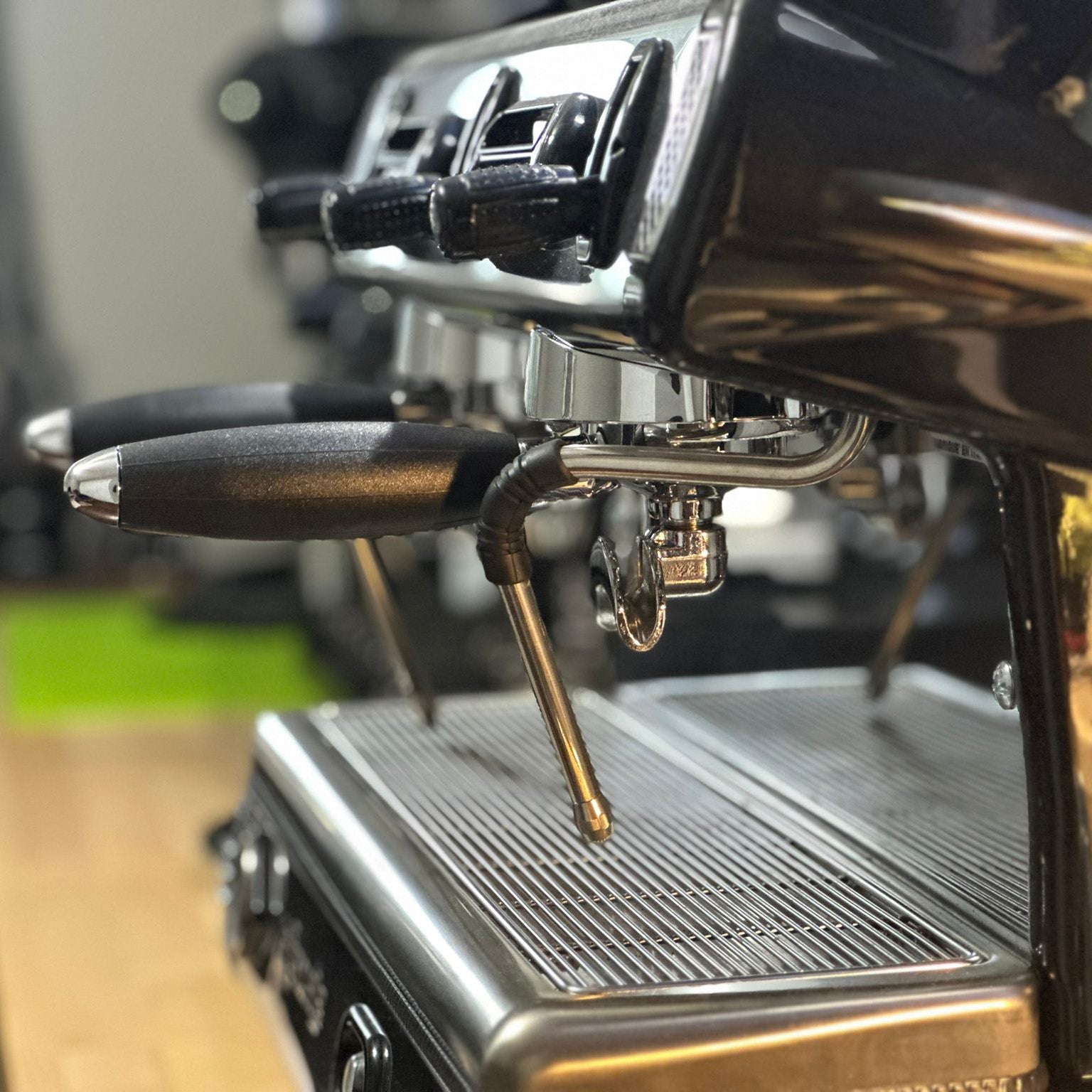
The presentation dates Giuseppe Bambi’s horizontal-boiler patent to 1939. Arranging the machine horizontally provided a different way to position multiple groups and organize the barista’s workspace.
Boiler orientation is a layout decision, not the same thing as the number of boilers. A horizontal boiler does not, by itself, mean independent brew-temperature control. Nor does it prove easier maintenance in every machine: access to valves, heaters and plumbing depends on the complete assembly.
1970: GS, dual boilers and saturated groups
The GS milestone is dated to 1970, combining separate brewing and steam boilers with saturated brew groups. The value of separating the circuits is that brewing and steam production have different temperature requirements.
A saturated group is thermally connected to its brew-water system so that the group’s temperature is closely tied to that circuit. This differs from assuming that a heavy external group becomes stable simply because it contains a lot of metal. Sensor placement, circulation and control remain important. Our temperature-stability guide explains what stability means during repeated brewing.
Why these ideas mattered in cafés
A café needs to repeat a recipe while steam demand changes. Separating thermal duties offers engineers more control over that interaction. It does not remove the need for warm-up, water treatment, a suitable grinder or consistent puck preparation. Two machines that both advertise dual boilers can still differ in group design, recovery and service access.
For a business, evaluate the busiest service interval and the complete station. Group spacing, cup clearance, milk workflow and technician access all affect operation. A historic innovation should not be converted into an unsupported guarantee that every later machine is superior for every café.
2015: the Linea Mini and home use
The corporate history dates the Linea Mini to 2015. Bringing a café-inspired approach into a kitchen created a different use case: fewer drinks, tighter space and an owner responsible for both brewing and maintenance. Later revisions and other home models must be checked individually; features advertised today should not be retroactively assigned to the original release.
Ownership history and buying context
The December 2023 presentation also announced a proposed professional-coffee combination involving La Marzocco and Eversys under De’Longhi Group. An announcement date is not itself proof of the transaction’s completion date. Ownership history should remain separate from the specifications of a machine on your counter.
When comparing equipment, identify model, year and market, then read its installation and operating documentation. Our boiler-material guide and Alex Duetto dual-boiler guide provide further context. For the earlier development of pressure-based brewing, see espresso-machine invention.