


How Much Steam Power Does a Coffee Shop
Coffee Business Resource Center
If most of your orders are lattes and cappuccinos, steam performance deserves as much attention as the number of espresso groups.
A machine can have an available group while finished espresso waits for milk. Buying another brewing position won't necessarily resolve that delay.
Start by measuring the milk work during your busiest service. Then test the proposed machine, steam configuration, and staff routine against that workload.
Count hot milk drinks separately
Use sales records and order timestamps where available. Separate hot milk drinks from iced drinks, straight espresso, brewed coffee, and drinks that use hot water.
Record the actual sizes and recipes. Ten small cappuccinos and ten large lattes are not the same steaming task.
For a new shop or cart, create a clearly labeled estimate. Ask what happens when several milk drinks arrive together, rather than averaging them across the entire day.
At an event, the service schedule matters. A crowd released during a short break can create a different problem from steady orders over several hours.
Translate the menu into milk to prepare
Use the cold milk quantity in your established recipe, not the final cup capacity. Espresso, foam, headspace, and other ingredients make those different quantities.
For a hypothetical fifteen-minute period, imagine the following hot-drink mix:
| Drink group | Number ordered | Assumed cold milk per drink | Milk to prepare |
|---|---|---|---|
| Lattes | 20 | 200 mL | 4.0 L |
| Cappuccinos | 10 | 140 mL | 1.4 L |
| Total | 30 | Recipe dependent | 5.4 L |
These invented recipes illustrate the calculation. The total describes milk to heat and texture, not steam-water consumption or a required boiler size.
Now include milk types and how staff will divide the work into appropriate pitchers. Alternative-milk orders and different serving temperatures can change the sequence even when the total volume is similar.
Don't batch milk merely to make the calculation look efficient. Follow your recipes and food-safety procedures, and measure the waste created by the method you actually use.
Understand reserve and recovery
A steam boiler stores hot water and steam. When steam is drawn, the system uses stored energy, and the heating element replaces energy as the machine operates.
Boiler size is part of the reserve. Heating power, controls, water level, incoming water, and simultaneous work influence recovery.
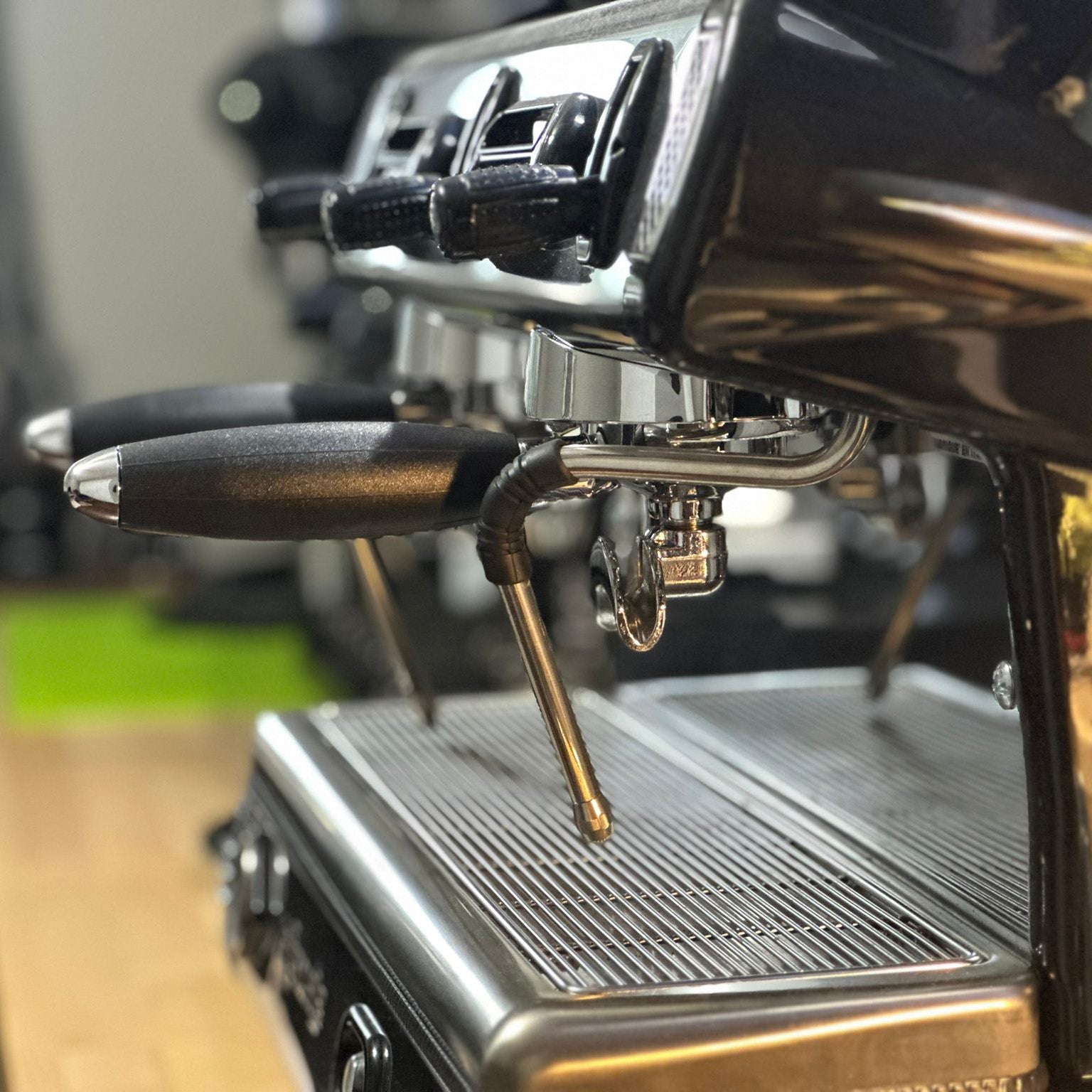
The steam path matters too: valves, wand, tip, and their configuration affect delivery and control. Staff technique and pitcher choice influence how effectively that delivery is used.
Our steam boiler and recovery explainer covers these relationships. For an equipment purchase, use them to ask better questions rather than trying to convert a boiler-liter figure into a guaranteed drink rate.
Compare the exact electrical configuration
Two machines with the same group count can have different heating arrangements. Even versions of the same model can differ.
For example, Simonelli's U.S. Appia Life Compact sheets list 1,500 watts for the 110–125V version and 3,000 watts for the 208–240V version. 110V sheet, 220V sheet.
Those figures do not prove twice the steaming speed or twice the output. They show why the exact configuration belongs in the comparison.
Have the installer assess the required supply and complete load. On a cart or trailer, include refrigeration, pumps, grinders, water heating, and the proposed power source.
Include hot-water drinks in the test
If the espresso machine supplies Americanos or tea, include those orders during the steaming demonstration.
Hot-water draws and subsequent refill can change the work the heating system must do. The effect depends on the machine's water arrangement and control strategy.
Ask whether a suitable separate hot-water source would help your particular menu. Compare its purchase, installation, space, and operating requirements with the benefit.
Keep the test realistic. A milk-only demonstration can miss an important load if your actual rush includes many hot-water drinks.
Check whether two wands help your team
Two steam wands create two working positions. They do not by themselves establish that the machine can sustain any amount of simultaneous steaming.
Demonstrate the way your staff will use them. Can two people access milk, pitchers, and cups without crossing? Does the system maintain useful performance through the repeated sequence?
One skilled barista may not benefit from a second wand in the same way as a team with a dedicated milk role. The station needs to make that role practical.
If one wand is intended for a particular milk workflow, write down the procedure and cleaning requirements. Don't turn a staff convention into an unsupported allergen claim.
Value control as well as speed
Very fast steaming is not helpful if the team regularly overshoots the desired result or wastes milk.
Use the intended pitcher sizes, milk types, and recipes in training. Check that the operator can produce the texture and serving temperature consistently.
If considering an automated steam or milk option, test the exact configured system. Ask how recipes are changed, what staff still do, and what cleaning it requires.
Some commercial platforms offer optional milk functions. Verify them on the quote rather than assuming they are included because they appear in a range brochure.
Run a sustained, mixed-order demonstration
Bring a representative sequence and use the staffing arrangement you plan to schedule. Start with the machine prepared according to its manual.
Record order entry, drink completion, and handoff. Watch milk preparation, espresso availability, refilling, pitcher cleaning, and the points where work waits.
Include both a busy run and the first drinks after an idle period. For mobile service, repeat the test with the approved supply arrangement that will actually be used.
If performance changes during the run, ask the supplier to explain and investigate it. Don't compensate by altering internal pressure or temperature settings outside the manufacturer's instructions.
Diagnose the delay before replacing the machine
If steaming has become slower on an existing setup, record when the change began and what else changed: menu, milk quantities, staff, water treatment, maintenance, or supply.
Follow the operator checks in the manual and involve a qualified technician for faults or internal work. A restricted or malfunctioning component is a different problem from buying a machine too small for the service.
Keep service and water records so the technician has useful background. Don't make staff guess at the cause from the sound of the wand alone.
Choose from the observed workload
You should finish with a defined hot-milk workload, a mixed-order sequence, a staffing plan, and an explanation of how the proposed machine performs.
Compare that result with the installed cost and support available. Consider the machine, grinders, milk station, and any separate hot-water equipment together.
Our commercial team can use those details to help choose a setup around your actual service.
Sources and further reading
- Simonelli: Appia Life Compact 110V installation sheet.
- Simonelli: Appia Life Compact 220V installation sheet.
- Simonelli USA: model-specific manuals.
- Espresso Outlet: steam boiler size, pressure, and recovery.
Sources checked September 8, 2026. The drink quantities and milk volumes are hypothetical and do not establish an equipment capacity rating.