


How Many Group Heads Does Your Coffee Shop
Coffee Business Resource Center
To decide how many group heads your coffee shop needs, start with the orders that arrive together. Then count the work required to make them.
The aim is to find out whether espresso brewing is likely to become a constraint and whether the rest of the bar can support the proposed machine.
A simple calculation can help you ask better questions. A realistic service test is what turns those questions into a buying decision.
Choose a busy period worth designing for
For an existing shop, review order timestamps and product sales across several representative days. Look at short busy periods as well as the total hour.
Averages can hide a queue. Thirty drinks spread evenly across an hour create a different workload from thirty ordered in the first fifteen minutes.
For a new shop, write down an estimated peak and explain where it came from. Local observation, comparable operating experience, and planned customer occasions can inform it, but it remains an assumption until measured.
For a cart, consider the event schedule. A conference break, a wedding service window, and a long market session can create very different arrival patterns.
Decide what level of waiting you are trying to serve. There is no single acceptable queue time for every business, but your equipment and staffing choices should support a clear service goal.
Turn drink orders into extraction cycles
Count the separately prepared espresso extractions needed for the menu. Avoid using “shots” without defining the recipe.
A drink using one double-basket extraction needs one cycle. A larger drink using two separately prepared extractions needs two cycles. Batch-brew coffee doesn't occupy an espresso group, although it still creates other work.
Include decaf, extra espresso, and realistic allowances for recipe checks or remakes in the test. Don't quietly treat every drink as the simplest item on the menu.
For a hypothetical fifteen-minute period, suppose customers order 30 espresso-based drinks. If 27 use one extraction and three use two, the total is:
27 × 1 + 3 × 2 = 33 extraction cycles.
That is the group workload for this example. The number of customers or cups alone would not show it.
Estimate how long a group is occupied
Measure the time a group is unavailable for another extraction during the working sequence. Include brewing and the model-appropriate steps needed to remove the portafilter and make the group ready again.
Keep this separate from preparation that can happen elsewhere while an extraction runs. Grinding and tamping still require labor and equipment time, but don't count them twice as group occupation if they occur in parallel.
For this teaching example, assume each cycle occupies a group for 45 seconds. This is an invented input for the calculation, not a recommended extraction time or a manufacturer specification.
With 33 cycles, the example needs 1,485 group-seconds: 33 multiplied by 45.
Compare that work with the time available
Fifteen minutes contains 900 seconds. One group therefore provides 900 group-seconds in that interval; two provide 1,800; three provide 2,700.
| Group count | Available group-seconds in 15 minutes | Example workload as a share of that time |
|---|---|---|
| One | 900 | 165% |
| Two | 1,800 | 82.5% |
| Three | 2,700 | 55% |
Under these assumptions, one group cannot complete all the required cycles within the interval. Two groups have enough total group time on paper, but the schedule is tightly occupied. Three leave more unused group time.
This does not prove that two or three groups can complete the drinks on time. The table assumes the work can be scheduled effectively and says nothing by itself about milk, grinding, staff movement, thermal performance, or uneven order arrivals.
There is also no universal “safe” percentage in this table. The figures are a way to identify a question for testing, not a capacity rating.
Look inside the fifteen minutes
An aggregate calculation can hide the point when the queue forms. If many of the orders arrive in the first few minutes, the bar may fall behind even though the total work fits the full interval.
Record arrival and completion times during a rehearsal or actual service. Watch whether the queue shrinks once the first cluster is served or keeps growing through the rush.
Include customers with several drinks in one order. The handoff may wait for the slowest drink, even when some components are already complete.
For events, talk to the organizer about the service window and how guests will be directed to the cart. A booking's guest count doesn't establish how evenly they will arrive.
Test milk and hot water at the same time
Groups can have spare time while milk preparation limits the bar. Use the actual mix of hot milk drinks, iced drinks, alternative milks, and hot-water drinks.
Watch steaming, pitcher handling, refrigerator access, and drink finishing. Repeat the sequence long enough to resemble the intended service rather than stopping after a few easy orders.
Ask the supplier how the selected machine and configuration support sustained use. Boiler and power specifications help describe the machine, but they aren't a finished-drinks-per-hour equation.
For example, Simonelli publishes different electrical specifications for 110V and 220V Appia Life Compact versions. Confirm the actual configuration rather than treating all compact two-group machines as equivalent.
Check whether the grinders can feed the machine
Measure the dosing and preparation work across the same sequence. Include adjustments, switching coffees, and the method you plan to use for decaf.
If groups sit empty while prepared coffee is unavailable, adding another group doesn't address that delay.
Compare commercial grinders for the coffee program and working pattern, and demonstrate them with the proposed machine where possible.
Also look at where tools are placed. Repeated reaching, crossing, and clearing space can consume time that isn't visible on an equipment specification sheet.
Use the staffing plan you can actually afford
A demonstration with several experienced people around the bar may not reflect a shop opening with one barista and one cashier.
Practice with the roles you intend to schedule. Decide who takes payment, doses coffee, handles milk, prepares food, restocks, and hands over orders.
Watch when someone must leave their main task. The espresso station may work smoothly until the same person has to collect food or fetch more milk.
Include paid staffing in the financial plan. Equipment capacity that depends on labor you haven't budgeted for is not yet a workable operating plan.
Leave room for the extra group to be useful
Compare the complete station footprint. A wider machine may displace a grinder, pitcher area, or handoff position.
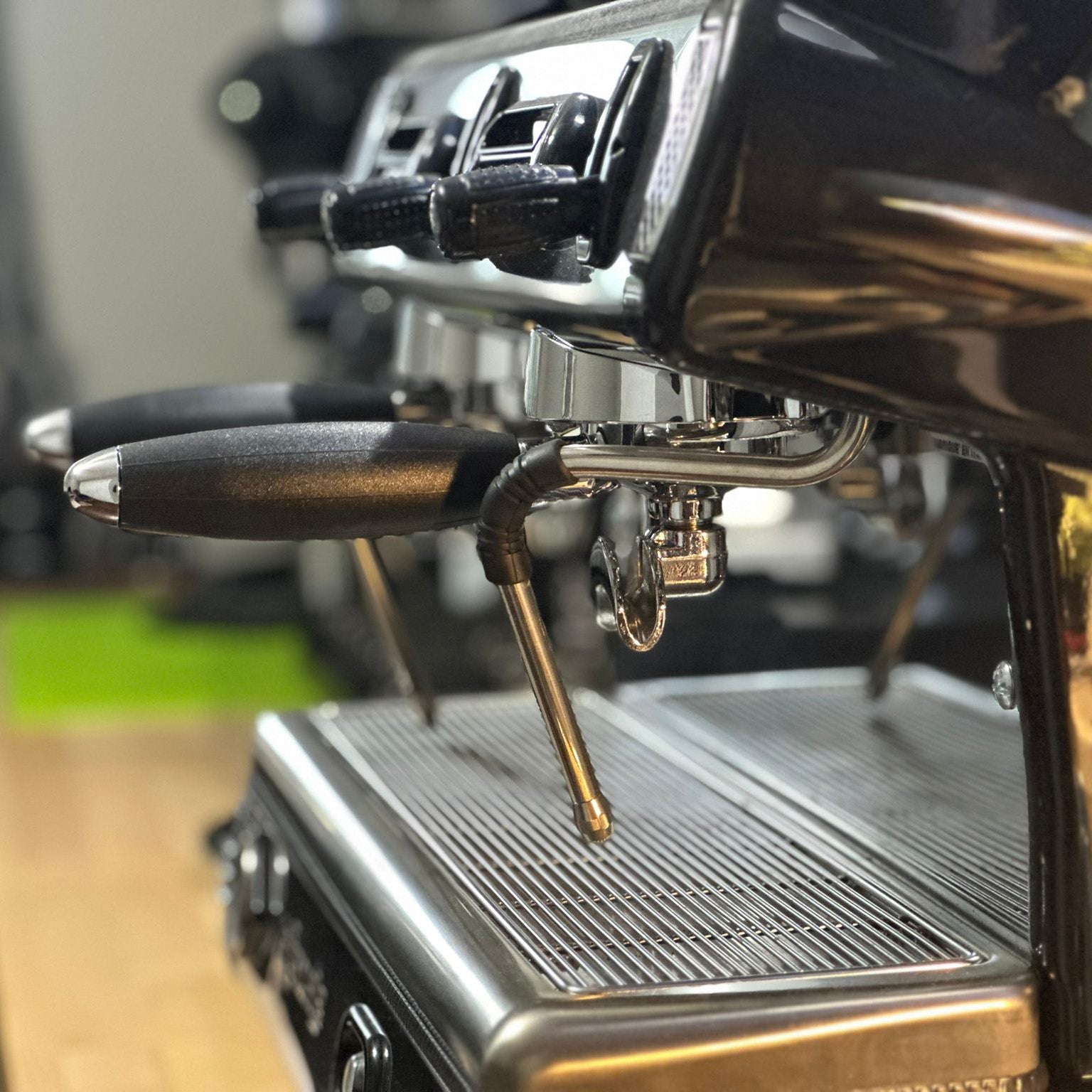
Simonelli's U.S. Aurelia Wave sheets, for example, list the two-group at 32 inches wide and the three-group at 41 inches. That extra brewing position occupies nine additional inches before allowing for the surrounding station. Two-group sheet, three-group sheet.
On a cart or trailer, also check the installed load, transport arrangement, and complete utility supply with the professionals responsible for the build.
The result should improve the whole service, not just the group-time calculation.
Bring the results to the equipment conversation
You should now have a peak order sequence, a count of extraction cycles, observed preparation and finishing times, a staffing plan, and a counter layout.
Use those to ask for a demonstration and a configuration-specific quote. If the group-time calculation looks tight, test the next size and compare the effect. If another task is causing the queue, address that before assuming you need more groups.
Our commercial team can use this information to help narrow the machine options. It is much more useful than a daily cup target on its own.
Sources and further reading
- Simonelli USA: equipment documents, including the configuration and footprint sheets linked above.
- Appia Life Compact 110V installation sheet.
- Appia Life Compact 220V installation sheet.
Specifications checked September 8, 2026. All demand, timing, and utilization figures in the worked example are hypothetical. The calculation is a planning exercise, not a measured performance claim.