


Why More Espresso Pressure Does Not Always Mean Faster Flow
For decades, espresso has often been explained with a simple rule: pressure pushes water through coffee, so more pressure should create more flow. In practice, baristas know it is not that simple. A shot can slow down, become unstable or channel even when the pump pressure rises.
A 2026 physics study provides a clearer explanation. Researchers found that at lower pressures, a bed of ground coffee behaves much like an ordinary porous material. As pressure enters the range normally used for espresso, however, the puck begins to deform. The spaces through which water travels can narrow, and flow may stop increasing even as pressure continues to rise.
The research, summarized by Daily Coffee News, does not give baristas a single new recipe. It does something more useful: it explains why pressure, grind size, dose and puck preparation cannot be treated as independent variables.
What the researchers tested
The research team used a commercial two-group espresso machine equipped with additional sensors and data collection hardware. Shots were brewed across basket pressures ranging from approximately 1 to 12 bar. The experiments included long extractions designed to show how the coffee bed behaved after most soluble material had already washed out.
At low pressure, flow rose in a relatively predictable way as pressure increased. In the range commonly associated with espresso—roughly 6 to 9 bar—the relationship changed. Flow began to level off instead of continuing to climb.
The researchers modeled the puck as a poroelastic material: a porous structure that can swell, compress and change shape while water moves through it. X-ray imaging of brewed pucks showed cracks, swelling and separation inside the coffee bed. Those structural changes help explain why two shots made with apparently identical settings can behave differently.
Why higher pressure can work against flow
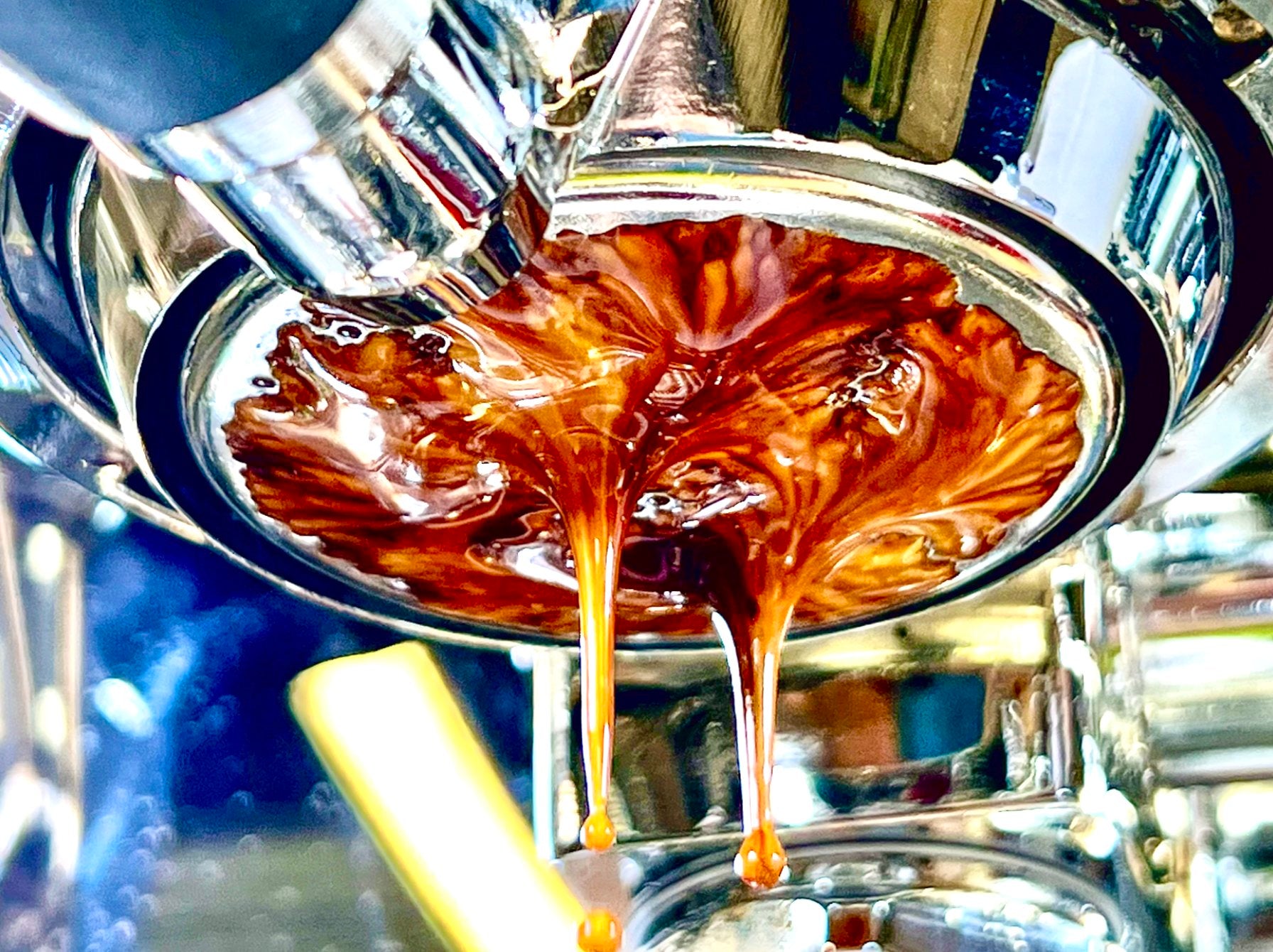
An espresso puck is not a rigid filter. It contains particles of many sizes, pockets of air and pathways that change during brewing. Increasing pressure may initially push more water through those pathways. Higher force can also compress the coffee bed, reduce permeability and encourage water to find a weaker route.
This helps explain several familiar observations:
- A very fine grind may produce less flow even when pump pressure is high.
- A shot can begin evenly and develop channeling later.
- Increasing pump pressure does not necessarily rescue a slow extraction.
- Stopping and restarting a shot may change flow without extracting useful additional flavor.
- Pressure readings alone cannot tell you whether water is moving evenly through the puck.
For a broader explanation of gauge readings, see our guide to espresso machine pump pressure. It distinguishes static pressure from the pressure measured while water is actually moving through coffee.
What this means for dialing in espresso
The practical lesson is not that pressure is unimportant. It is that pressure should be evaluated together with flow, time, yield and taste.
Start with grind size, not the pressure adjustment
If a shot is choking or barely dripping, grinding slightly coarser is usually more useful than increasing pressure. A coarser setting can restore permeability throughout the puck instead of simply forcing water toward a crack or edge gap.
Keep dose and headspace consistent
Changing dose changes puck depth and the room available for coffee to swell. Use a dose appropriate for the basket, weigh it consistently and avoid assuming that every basket labeled “18 gram” behaves identically with every coffee.
Improve distribution before chasing machine settings
Clumps, uneven density and disturbed puck edges create easy pathways for water. A repeatable distribution and tamping routine gives pressure a more uniform coffee bed to work against. Our espresso shot profile guide explains how pre-infusion, flow and pressure interact during the shot.
Judge the cup, not just the gauge
A pressure gauge is a diagnostic tool, not a flavor meter. Record dose, beverage yield, time and taste. If available, observe flow from a bottomless portafilter, but remember that an attractive-looking stream does not guarantee even extraction inside the puck.
Does the study prove that 9 bar is wrong?
No. Nine bar remains a useful conventional target because many machines, baskets and recipes are designed around it. The study does not establish one universally ideal pressure, nor does it show that lower pressure always tastes better.
Instead, it challenges the assumption that more pressure automatically produces more flow or better extraction. A well-prepared puck at moderate pressure may be more consistent than a poorly prepared puck subjected to greater force.
Why flow-control machines are useful
Machines that provide pre-infusion, pressure profiling or manual flow control allow the barista to manage how quickly the puck becomes saturated. A gentle start can reduce the initial stress placed on weak areas before full brewing pressure develops.
Home baristas interested in experimenting can compare the capabilities in our Turin espresso machine collection and the broader home espresso machine collection. The important point is not to change every variable at once. Establish a repeatable baseline, make one controlled adjustment and evaluate the result in the cup.
The takeaway
Pressure does not act on a passive puck. Coffee swells, compresses, dissolves and sometimes fractures while the shot is running. That is why more pressure does not always produce more flow—and why good espresso depends on the entire system rather than a single gauge reading.
The new research gives scientific support to what experienced baristas have learned through practice: grind quality, distribution, dose, pre-infusion and flow matter at least as much as the maximum pressure printed on a machine’s specifications.