


Commercial Espresso Machine Cleaning
Coffee Business Resource Center
An espresso-machine cleaning checklist should make the routine repeatable without pretending every machine cleans the same way. Traditional machines, lever designs, and super-automatics can require different procedures and products.
Start with the manual for the exact machine and configuration, then write the operator routine around it. Confirm which tasks employees are trained and permitted to perform. Internal repairs, pressure-system work, and descaling decisions need the appropriate qualified support.
The checklist below is a planning aid for organizing that routine, not a universal set of backflushing instructions.
Identify the machine and approved materials
Keep the model, manual version, required cleaning products, suitable brushes, approved removable parts, and operator instructions together. Label chemical containers and store them appropriately away from food. Follow the product's safety information and required handling precautions.
Do not assume an espresso detergent, milk-system cleaner, sanitizer, and descaler are interchangeable. Choose the product for the task and equipment. Do not mix chemicals or increase the concentration because a part looks particularly dirty.
For example, Urnex's Cafiza Powder instructions describe separate backflushing and accessory-cleaning uses, including rinsing and discarding the post-cleaning espresso. Confirm that the product and method are compatible with your equipment before applying them.
Keep routine care going during service
Use the trained group, basket, portafilter, and steam-wand care appropriate to the machine as drinks are made. Remove spent coffee through the intended waste route and keep the working area orderly.
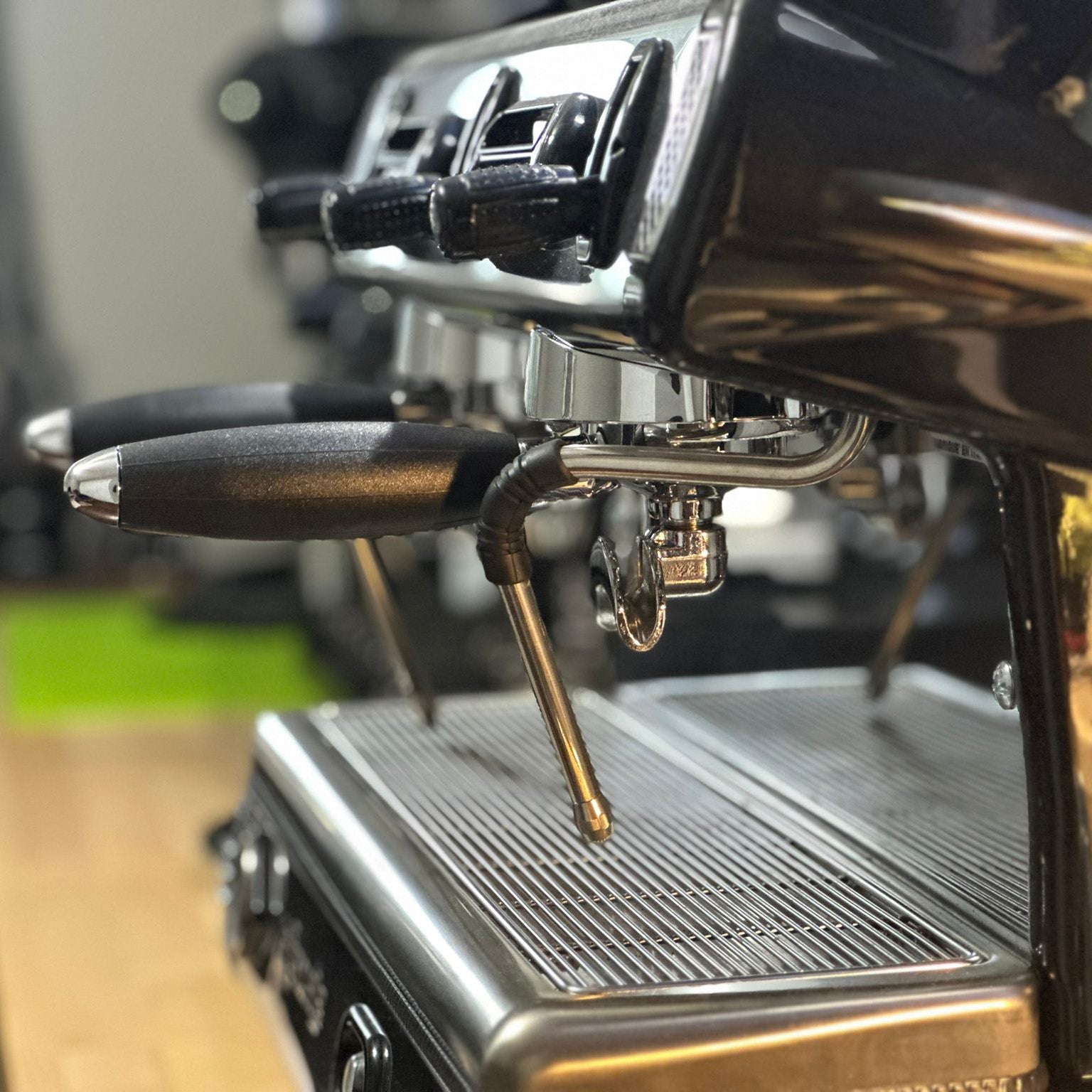
The Linea Classic S manual includes steam-wand purging and external cleaning instructions. Apply your machine's procedure and the appropriate cloth-handling routine. Do not leave milk residue to harden while assuming the closing clean will make every task equally easy.
Keep clean and dirty utensils distinct. A pitcher rinser helps remove residue during workflow, but your required cleaning and sanitizing process still applies to food-contact equipment. As one jurisdictional example, Washington's sanitizing rule requires sanitizing applicable food-contact surfaces before use after cleaning. Use the rules and accepted methods for your location.
Build the end-of-service checklist
| Area or task | What the operator confirms |
|---|---|
| Machine status | Service stopped and equipment placed in the state required for each cleaning task |
| Groups | Approved cleaning method completed for the specific design, including required rinse steps |
| Baskets and portafilters | Permitted parts cleaned, thoroughly rinsed, inspected, and returned correctly |
| Steam wands or milk system | Model-specific cleaning completed with the appropriate product and tools |
| Tray and accessible drain area | Residue removed and components cleaned without pushing grounds into drains |
| Exterior and working area | Cleaned by an approved method that protects controls and electrical components |
| Return to service | Reassembly, required rinse or discard steps, and functional checks completed |
| Record | Completion and any leak, damage, blockage, or unresolved issue documented |
Add the actual procedure reference, employee initials, and date to the working version. The table identifies the work; the equipment instructions establish how to do it.
Treat powered cleaning cycles as a defined task
Some cleaning cycles require the machine to be powered and operating. Other cleaning or maintenance tasks require isolation and cooling. Follow the specified state for each task rather than applying one blanket instruction to the entire machine.
Keep people clear of hot liquid and steam, and do not remove a portafilter while the group is actively brewing or under an unsafe condition. The Linea Classic S manual warns against water jets or splashing the appliance during cleaning. Use the corresponding precautions in your equipment's documentation.
If the machine is not designed for backflushing, do not fit a blind basket and try it anyway. For a super-automatic, use its specified cleaning program, tablets or products, and milk-system routine. A procedure demonstrated on a traditional machine does not transfer automatically.
Clean removable parts without damaging them
Confirm which parts can be removed by the operator and which materials may contact the cleaning solution. Keep handles, coatings, seals, and other sensitive components out of a soaking process unless the manufacturer permits it.
Use the stated concentration, contact time, rinse method, and handling precautions. Inspect parts as they are cleaned and report damage or wear. Do not scrape sensitive surfaces with an improvised sharp tool to speed up the process.
Return parts to their correct locations and verify they are secure. A cleaning routine that leaves a basket missing or a component assembled incorrectly is not finished.
Verify before the next customer drink
Complete the required rinse sequence and any manufacturer-specified post-cleaning discard step. Check that the equipment behaves normally and that no cleaner or loose part has been left in the service path.
Do not substitute “it smells fine” for completing the procedure. If there is uncertainty about chemical residue, reassembly, or an error message, stop and resolve it through the appropriate instructions or support.
The next opening check should confirm the station is ready, but it should not be the first time anyone notices that cleaning was incomplete. Record unresolved issues in the closing handoff.
Make cleaning time part of the schedule
Provide the products, tools, and paid time needed to do the routine. Watch a trained employee complete it and identify difficult access or missing supplies. Improve those conditions rather than asking for a signature on a task that cannot realistically be finished.
For a cart, plan where the full cleaning process happens, how water and waste are handled, and how cleaned equipment is protected in transport. Venue access ending at a certain time does not eliminate the work; it means the booking and preparation plan need to accommodate it.
Ask Dylan and the commercial equipment team about operator training and documentation when choosing equipment, and use qualified service support for tasks beyond the operator routine.
Sources and further reading
- La Marzocco: Linea Classic S manual — model-specific cleaning and safety instructions.
- Urnex: Cafiza Powder instructions and safety resources — product-specific use, rinsing, and post-cleaning discard.
- Washington WAC 246-215-04705 — jurisdiction-specific sanitizing requirement.
Sources reviewed September 9, 2026. Adapt the checklist to the exact equipment and applicable local procedures.