



How to Design a Coffee Trailer for Fast
Coffee Business Resource Center
A fast coffee trailer gives each person enough room to finish a drink without waiting for someone else to move. That sounds simple until an open refrigerator blocks the aisle, the second barista needs the same sink, and the person taking payments stands in front of the cups.
Start with the work, then place the equipment. The layout should make the normal service sequence easy while still allowing handwashing, cleaning, restocking, and a clear route out.
Draw the journey of one order
Write down how an order moves from customer to finished drink: selection, payment if applicable, cup identification, grinding, preparation, extraction, milk or other finishing, and handoff.
Mark who performs each step. A solo operator needs a compact working arrangement that minimizes repeated travel. Two staff need clear responsibilities and enough room to work together without reaching through the same space.
Do the exercise for several orders, including an iced drink, decaf, an alternative milk, and an order with more than one cup. Those variations reveal storage and communication needs that a single latte demonstration misses.
Decide where customers order and collect
If customers pay individually, give them a clear place to order and enough visible menu information to choose before reaching the operator. Place the handoff so completed drinks do not compete with the next payment.
For catered service, payment may disappear from the workflow, but order identification still matters. Decide how staff will distinguish similar drinks and how guests will know their order is ready.
Review the area outside the trailer as part of the design. The queue should fit the permitted pitch and leave the venue's required access clear. A service window placed beautifully on the drawing can still face the wrong side of a real event space.
Put the busiest actions within a workable reach
Use the actual operators and equipment dimensions to test placement. Do not assume a single “ideal” counter height or reach distance works for everyone.
| Repeated action | Layout question to test |
|---|---|
| Get a cup and mark the order | Can the order taker do this without occupying the espresso station? |
| Grind, prepare, and load a portafilter | Are the grinder, scale, tamper, and group arranged without awkward crossings? |
| Retrieve and return milk | Does the refrigerator open without blocking another worker? |
| Finish and hand off a drink | Is there a clear landing area protected from the dirty-tool route? |
| Restock cups, milk, or beans | Can stock reach the station while drinks continue? |
| Wash hands and clean tools | Are the required facilities accessible during the rush? |
The test is whether staff can perform the action comfortably and consistently. Avoid shrinking clearances to squeeze in another appliance that adds less value than the working space it removes.
Treat milk service as a whole sequence
Milk drinks involve retrieving milk, choosing a pitcher, steaming, pouring, returning milk, and moving the used pitcher into the approved cleaning workflow. Place those tasks together where possible without compromising required separation and access.
Check refrigerator ventilation and installation requirements. The most convenient location for the barista may be too close to a heat source or too enclosed for the selected refrigerator.
Store the most-used ingredients where they can be replenished easily. Keep less-frequent items out of the immediate work area, but make their location obvious. Staff should not search several cabinets when a decaf or alternative-milk order arrives.
Match the machine to the station
More groups can create more brewing positions, but they do not automatically solve a slow trailer. If one person takes orders, steams milk, and hands off every drink, another group may spend much of the event idle.
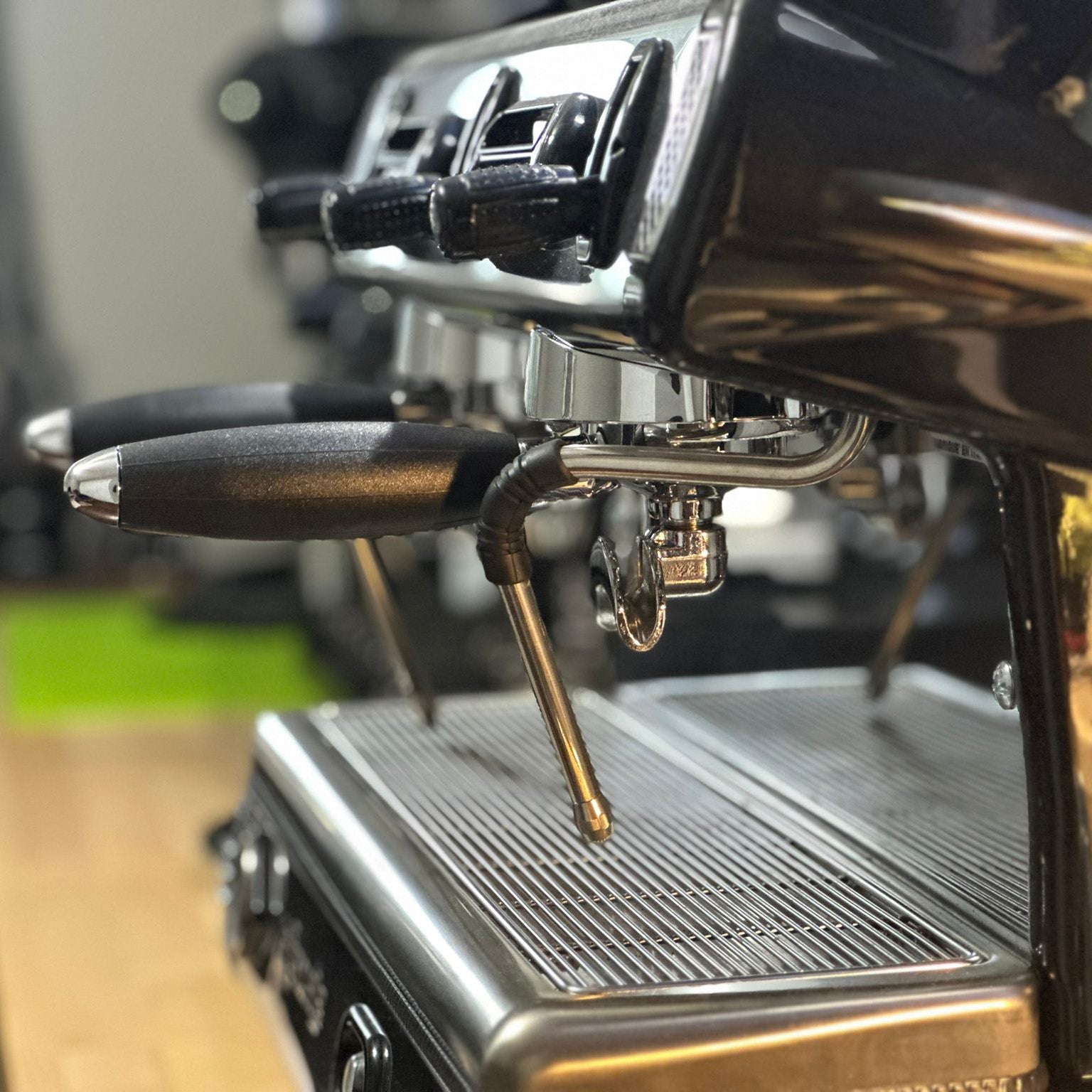
Compare machine footprint, sustained steam performance, supply requirements, and staff access together. Our compact commercial machine guide explains why physical size and practical capacity are different questions.
If batch coffee is part of the offer, consider whether it should have a separate handoff arrangement. That can give guests a quick option, provided the preparation, holding, and service plan suits the event and local requirements. Avoid routing every simple refill through the espresso station.
Reserve space below the counter before closing the drawing
Tanks, filters, pumps, plumbing, electrical components, and refrigeration compete for the same space. Include their connections, ventilation, service access, and removal clearances on the plan.
Use exact equipment documents. Nuova Simonelli's Appia Life Compact installation sheets, for example, specify connection and drain requirements for the particular electrical version. A counter footprint alone is not an installation drawing. Appia Life Compact 220V specification
Coordinate the plan with the builder and relevant trades. A drain route that crosses a structural member or a filter installed behind a tank can force changes after fabrication.
Keep cleaning and handwashing available during service
A fast layout must support the required hygiene routine at its busiest moment. Do not use the handwashing sink as temporary ingredient storage or let a line of dirty pitchers block access.
Show the planned equipment and sinks to the local reviewer before building. King County's mobile review guide, for instance, asks for scaled equipment layouts and water-system details. That is a local documentation example, not a universal dimensional standard. King County mobile plan-review guide
Test a full-size mockup
Before construction, mark the proposed equipment and aisle on the floor or use full-size cardboard stand-ins. Include open doors, drawers, protruding handles, and the actual number of staff.
Walk through a rush, a milk restock, and a cleaning interruption. Record where people wait, turn sideways, reach over each other, or move something simply to access another item.
After installation, repeat the test with real equipment under the approved utility setup. Measure the complete service sequence and adjust removable smallwares or staff roles before considering another major equipment purchase.
Our Mobile Coffee Series includes conversations and trailer walkthroughs that can help you notice details to test in your own design.