


How to Choose a Commercial Espresso
Coffee Business Resource Center
A commercial espresso machine should make your working day easier. The right choice lets your team produce the menu consistently, fits the space, and comes with an installation and service plan you can actually use.
Start with the work you need it to do. Once you understand that, specifications and features become much easier to compare.
Describe a busy service before making a shortlist
Write down the drinks you expect to sell during a busy short period. Include cup sizes, milk choices, decaf, extra espresso, and drinks that use hot water.
For an existing café, use order timestamps and product sales, then watch the bar to see where work accumulates. For a new business, build a clearly labeled estimate and test it as you learn.
Daily drink totals don't describe the whole task. A cart serving a conference break may receive most of its orders together. A neighborhood shop may spread a similar number across several hours.
Also describe how long the pressure lasts. A machine demonstration that makes a few drinks successfully doesn't establish how the complete bar will perform through a sustained rush.
Understand what the group count gives you
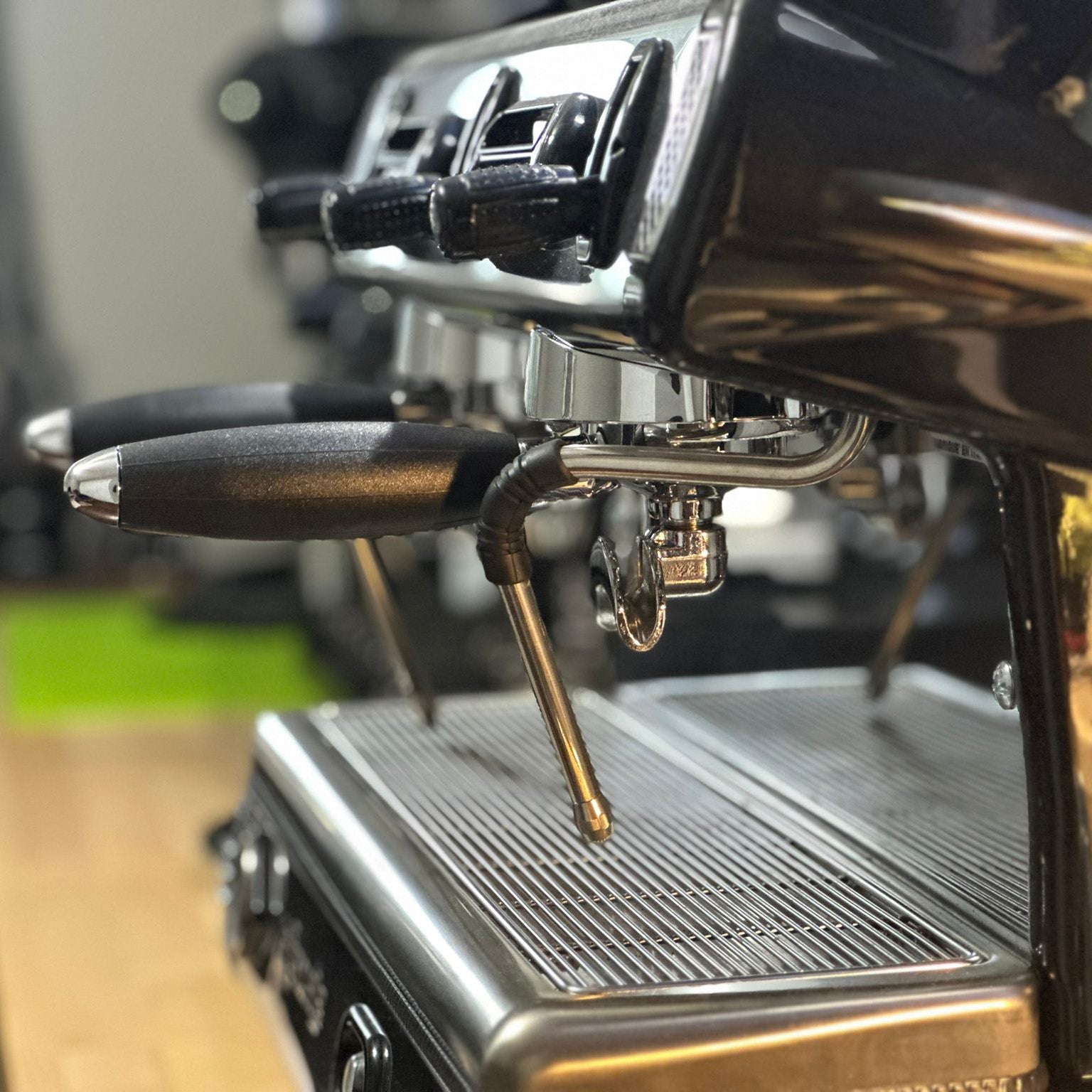
Each group provides a place to brew an espresso extraction. More groups create more opportunities for overlapping extractions, provided the team and the rest of the equipment can keep up.
One group may suit a compact operation with demand that has been tested against the setup. Two groups provide more scheduling flexibility. A third group is useful when the workflow regularly needs another available brewing position.
Those are operating considerations, not daily-cup limits. Group count alone doesn't establish steam performance, thermal recovery, grinder speed, or finished-drink output.
A two-spout portafilter is also not a second group. It can divide one extraction between cups when the recipe calls for that; it doesn't create another independently prepared extraction.
Give milk service a proper test
If most of your menu is lattes and other milk drinks, steam performance matters alongside espresso brewing.
Ask to make your intended sizes in a repeated mixed sequence. Watch whether the operator waits for steam, whether milk preparation falls behind brewing, and whether the bar has enough pitcher and refrigerator access.
The number of steam wands doesn't tell you everything about sustained use. Boiler design, heating power, controls, the selected configuration, and how staff work all matter.
Include hot-water drinks in the demonstration. Ask whether a separate hot-water source would make sense for your menu rather than assuming the espresso machine should supply every hot drink.
Match the controls to the team
On a semiautomatic machine, the operator starts and stops the extraction. Volumetric models can stop a programmed dose using the machine's water-metering system.
Volumetric dosing can help organize repeatable work, but staff still need to check dose, beverage yield, and taste. A programmed button doesn't remove the need to dial in the coffee.
Other systems may offer beverage weighing, automatic milk functions, touchscreens, or more detailed recipe controls. Ask which functions are included in the exact quoted configuration and which are options.
Think about training and daily use. Can a shift lead change settings appropriately? Can new staff find the controls they need? How are cleaning cycles and alerts handled?
Ask the seller to demonstrate the tasks rather than reading only the feature list.
Compare boiler design without reducing it to a label
Heat-exchange and separate-boiler designs can organize brewing and steaming differently. The practical question is what control and performance the particular machine provides for your coffee and service.
If you need to run different brew temperatures for different coffees, ask exactly what can be adjusted and whether settings are shared or independent. A touchscreen or multiple group heads does not by itself establish independent temperature control.
Ask about the recommended operating routine, warmup, cleaning, and how the machine behaves during the sequence you intend to serve.
Use the model's current technical documentation. Features offered elsewhere in a manufacturer's range should not be assumed to exist on a similar-looking machine.
Fit the grinder and the rest of the bar into the decision
The machine can only brew coffee that has been prepared. A grinder, dosing method, or crowded preparation area can delay the bar while groups sit empty.
Plan the commercial grinders, tamping position, knock box, scales, milk storage, cups, and handoff together.
Include a workable method for decaf and any second coffee. Think about how often those orders arrive and how staff will prepare them without disrupting the main flow.
If you are replacing equipment, watch a real rush before deciding what to upgrade. Record where drinks wait. The useful purchase may be a machine, a grinder, a refrigerator change, or a combination.
Verify utilities for the exact version
Confirm voltage, amperage, connection requirements, water supply, treatment, drainage, and the installation clearances with the seller and qualified installer.
Configuration differences can be substantial. Simonelli's Appia Life Compact U.S. sheets list a 1,500-watt 110–125V version and a 3,000-watt 208–240V version. Both are compact two-group machines. 110V installation sheet, 220V installation sheet.
The difference in rated power is a reason to investigate the configuration, not a formula for doubling drink output. Have the complete electrical load and installation assessed.
For a cart or trailer, include every appliance and supporting system in that assessment. A venue's promise of “an outlet” doesn't establish that the available supply suits the machine and the rest of the operation.
Treat water as part of the equipment package
Use a water assessment and the selected manufacturer's requirements to choose treatment. A filter should be specified for the supply and the job it needs to do.
Ask who installs and services it, how changes are tracked, and what testing or replacement schedule applies to your setup. Keep the records with the machine information.
Simonelli's installation documents, for example, include water requirements as well as electrical requirements. Don't apply one manufacturer's figures universally to every machine.
For mobile businesses, discuss the proposed supply, pump, waste arrangement, and servicing routine with the builder, equipment supplier, and approving authority before ordering.
Compare complete quotes
Put quotes into the same format so you can see what each includes.
| Item to confirm | Why it matters |
|---|---|
| Exact model, groups, voltage, and options | Similar names can describe different configurations |
| Delivery and positioning | Freight arrival may not include moving the machine onto the bar |
| Water treatment and installation | The machine needs a compatible site and supply |
| Startup and staff training | Someone needs to commission the setup and teach its use |
| Warranty and service process | You need to know who to contact and what is covered |
| Cleaning supplies and maintenance | These become recurring operating requirements |
Ask about lead time and the conditions required for installation. Coordinate the equipment arrival with the build so it can be stored securely and installed when the site is ready.
Find out who will support it locally
Ask who handles service in your area, how a call is arranged, and whether parts and technical support are available for the model.
Read the actual warranty terms, including labor, travel, installation requirements, and exclusions where applicable. Don't infer coverage from another brand or an older purchase.
For used equipment, arrange an independent condition assessment and verify ownership, history, parts support, and compatibility with your site. Include likely work in the installed cost.
A machine that suits the menu but has a weak support arrangement may be difficult to live with when something goes wrong.
Finish with a demonstration that resembles your business
Bring a short sequence of realistic orders, your intended cup sizes, and the recipe requirements. Use the staffing arrangement you expect to have.
Watch complete drink handoff, consistency, and repeated operation. Note what slows the sequence and ask what change would address it.
You can discuss a shop or cart setup with our commercial team before choosing from the commercial espresso range. The most useful starting information is your menu, expected rush, layout, utilities, location, and budget for the complete installation.
Sources and further reading
- Simonelli USA: equipment documents.
- Appia Life Compact 110V installation sheet.
- Appia Life Compact 220V installation sheet.
Specifications checked September 8, 2026. Confirm the current documents and included features for the configuration on your quote.