


Breville Barista Touch Setup & Cleaning
Breville Barista Touch BES880 visual owner’s guide: setup, first espresso, grind correction, milk, cleaning and the questions owners ask most—organized as quick-reference cards and decision charts.
Breville Barista Touch at a glance
This is a practical starting map, not a replacement for the safety instructions supplied with the machine. Coffee density, roast level, age, water and taste all change the final recipe. Use the numbers below as diagnostic anchors, then let the cup decide.
First-use setup map
Wash removable parts, install the water filter, fill the tank and follow the touchscreen’s water-hardness and first-use prompts.
Run the guided flush, then warm the cup and portafilter with a blank shot.
Load fresh beans, start near the middle of the grind range, and set grind time conservatively.
Prepare the double basket, tamp and trim for headspace, then use the screen to record grind and extraction settings.
Official Breville Barista Touch setup video
Open Breville USA’s official Breville Barista Touch tutorial. The written guide below adds a taste-based dial-in system, symptom charts and ownership schedule so you do not have to jump between disconnected support topics.

The baseline espresso recipe
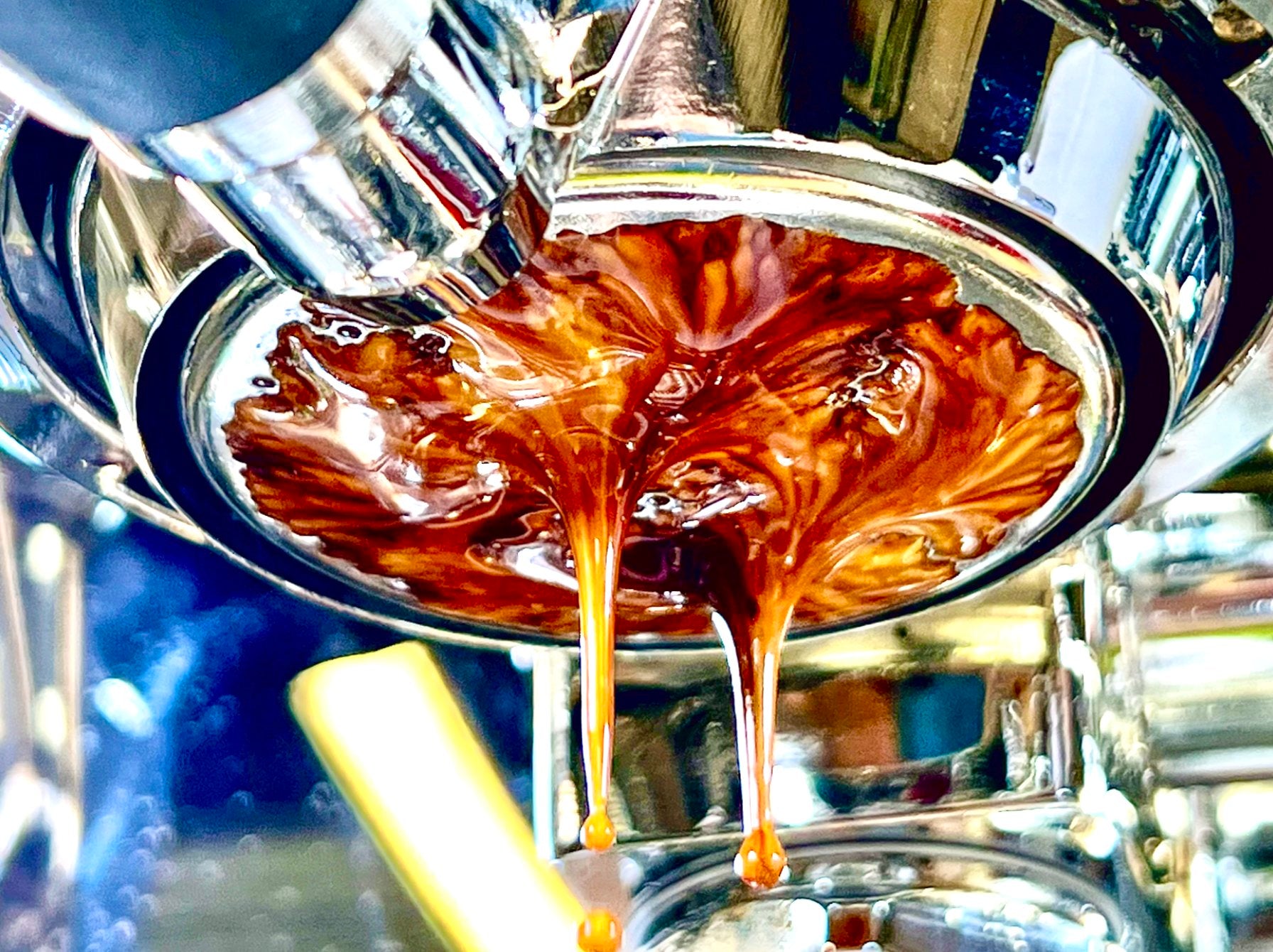
A 1:2 brew ratio—about 18 g of dry coffee yielding about 36 g of espresso—is a useful starting point, not a law. Count time consistently from the moment you start the shot. If the cup tastes balanced outside the window, keep the recipe. If it tastes sharply sour and runs fast, create more resistance. If it is harsh, dry and very slow, create less.
The touchscreen organizes the recipe, but puck physics are still manual. Weigh periodically, distribute evenly, tamp level and keep the rim clean. If a drink tile tastes wrong, fix the espresso recipe before masking it with milk or syrup.
Dial-in decision chart
| What you see or taste | Most likely causes | Change next |
|---|---|---|
| Fast, pale, thin and sharply sour | Grind too coarse; too little coffee; stale beans; uneven bed | Move finer first. Then verify dose, freshness, distribution and a level tamp. |
| Very slow, drips only, harsh or drying | Grind too fine; excess dose; blocked basket | Move coarser first. If the portafilter is tight or the puck touches the screen, reduce dose. |
| Spraying or uneven streams | Channeling from clumps, cracks, tilted tamp or grounds on the rim | Distribute more evenly, tamp level and keep basket and rim clean. Change only one prep step at a time. |
| Good time but hollow flavor | Recipe ratio or temperature does not suit the coffee | Taste a shorter or longer yield. Adjust temperature only after grind and ratio are repeatable. |
| Little crema | Older beans; very light roast; low resistance; dual-wall/single-wall mismatch | Check roast date and flow. Do not treat crema volume alone as a quality score. |
| Shot changes day to day | Beans aging; grinder retention; humidity; timed dose drift | Recheck dry dose and purge minimally after a grind change. Expect small corrections as beans age. |
Barista Touch recipe architecture: espresso first, milk second, save last
A saved drink is only as good as its two components. Dial in espresso as a straight shot, then tune milk temperature and texture, then save the combined drink. This sequence prevents a sweet milk setting from hiding an extraction problem.
Milk-texturing workflow
Fill the jug with cold milk and place it flat on the clean temperature sensor.
Set temperature and texture, lower the wand and start automatic milk texturing.
For manual practice, lift the wand and control aeration and rolling texture directly.
Wipe the wand before returning it; allow the automatic purge to complete.

Most-searched Breville Barista Touch questions—quick answers
These answers address the recurring setup, temperature, extraction, grinder, milk and care questions found across Breville’s support material and owner searches.
Does the Barista Touch tamp automatically?
No. Grinding is integrated and milk can be automatic, but distribution and tamping remain manual.
Can I save custom drinks?
Yes, up to the model’s supported saved-drink limit. Save only after espresso and milk are independently dialed in.
Why does the touchscreen recipe still taste sour?
A drink tile stores settings, not bean freshness or grinder calibration. Grind finer, verify dose and yield, and resave only when the shot tastes balanced.
Why is automatic milk inconsistent?
Keep the jug base and temperature sensor clean and dry, center the jug, begin with cold milk, and use a consistent fill level.
Can I use oat or almond milk?
Yes, though this model predates the dedicated alternative-milk profiles of Touch Impress. Lower starting temperature or texture may work better; adjust by brand and formulation.
How many grinder settings are there?
The U.S. BES880 configuration has 30 external settings. The correct setting depends on beans, age and recipe.
Why does the grinder run but little coffee exits?
The chute may be blocked, beans may be unusually oily, or the grind may be too fine. Stop, unplug before internal cleaning, and follow the grinder-cleaning procedure.
Can I change brew temperature?
Yes through the settings workflow. Treat temperature as a fine adjustment after grind, dose and yield are sensible.
Cleaning cycle or descale?
The cleaning cycle removes coffee oils; descaling removes mineral deposits. Follow each touchscreen prompt with the correct product.
Why is the machine asking for setup again?
A reset or interrupted setup can return it to onboarding. Confirm power, complete the prompts and contact support if settings repeatedly disappear.
Cleaning and maintenance timeline
| When | What to do | Why it matters |
|---|---|---|
| After every espresso | Knock out the puck, rinse the basket and portafilter, wipe the group area, and run a short water flush when appropriate. | Coffee oils and grounds bake onto hot surfaces and can disrupt sealing or flavor. |
| After every milk drink | Wipe the wand immediately, then purge it. Clean the jug and any milk-temperature sensor contact surface. | Dried milk can block steam holes, distort temperature sensing and create hygiene problems. |
| End of day | Empty and rinse the drip tray, refresh standing water as needed, wipe the exterior, and leave components clean and dry. | Prevents odor, overflow and residue buildup. |
| Weekly or with heavy use | Deep-clean baskets and portafilter with an approved method; inspect steam holes; clean the bean hopper and dry grinder-access areas as the manual permits. | Restores clean flow and catches buildup before performance changes. |
| When the machine prompts | Run the correct coffee-cleaning cycle with the specified tablet or cleaning material. | Removes coffee oils from the brew path; this is not the same as descaling. |
| Filter reminder | Replace the water filter at the instructed interval and reset the reminder. | An exhausted filter no longer provides its intended water treatment. |
| Descale prompt or manual interval | Use the model-specific Breville procedure and approved descaler. Complete every rinse stage. | Removes mineral scale. Never improvise boiler draining or mix chemicals. |
| As beans change | Brush the dry grinder path as instructed; never pour water into the burr chamber. | Oils and retained coffee affect dose and flavor; moisture can damage the grinder. |
Troubleshooting matrix
| Problem | Check in this order | Escalate when |
|---|---|---|
| No water or very low flow | Tank level and seating → filter installation → blocked basket → group flow without portafilter → required cleaning/descale prompt | The pump runs without restored flow after the approved cleaning steps, or the machine leaks internally. |
| Portafilter leaks around the group | Grounds on rim → basket overfilled → portafilter fully locked → gasket cleanliness | Leak continues with a clean, correctly dosed basket and undamaged portafilter. |
| Coffee is not hot enough | Preheat cup and portafilter → confirm settings → avoid excessive cold milk → complete scale care | Water remains clearly lukewarm after full setup, warm-up and maintenance. |
| Grinder dose is erratic | Fresh dry beans → hopper gate → grind setting → chute cleanliness → re-weigh timed dose | Motor sounds abnormal, burrs will not turn, or approved cleaning does not restore feed. |
| Steam is weak or uneven | Purge → wipe → inspect tip holes → run cleaning prompt → check scale care | Steam escapes from the machine, the wand will not clear, or heating faults appear. |
| Unexpected display, light or prompt | Read the exact message → complete the matching cycle → restart once → consult the model manual | The error returns repeatedly or involves heat, electrical smell, uncontrolled flow or a leak. |
Accessories and compatibility: what matters
- Match portafilter diameter: this model uses a 54 mm platform. Diameter alone does not guarantee that every third-party portafilter, basket or gasket has the correct ears, depth or clearance.
- Match basket dose to coffee density: an “18 g” or “22 g” label describes a useful range, not an exact capacity for every roast.
- Prioritize a scale and good grinder workflow: a 0.1 g scale usually improves diagnosis more than cosmetic accessories.
- Use approved cleaning materials: coffee detergent and descaler do different jobs. Avoid vinegar or improvised chemicals unless Breville explicitly approves them for this model.
- Check electrical requirements: use the U.S. machine on the rated circuit and avoid extension cords or voltage converters not permitted by the manufacturer.
A repeatable daily workflow
- Refresh water, confirm the tray and reservoir are seated, and warm the cup and portafilter.
- Use fresh beans. Prepare a dry basket and record the recipe when changing coffee.
- Brew on a scale until the grinder and yield are stable. Taste before changing a setting.
- Texture milk with clean equipment, combine promptly, then wipe and purge the wand.
- Rinse coffee-contact parts and leave the station ready for the next drink.
Shop and compare Breville Barista Touch
See the Breville Barista Touch product page, compare the complete Breville espresso machine collection, browse home espresso machines, or pair a separate-grinder model with an espresso-capable coffee grinder.
Espresso Outlet is an authorized Breville distributor serving U.S. customers. For fit, compatibility or order questions, contact us before purchasing. For electrical faults, internal leaks or warranty diagnosis, stop using the machine and follow Breville’s official support path.