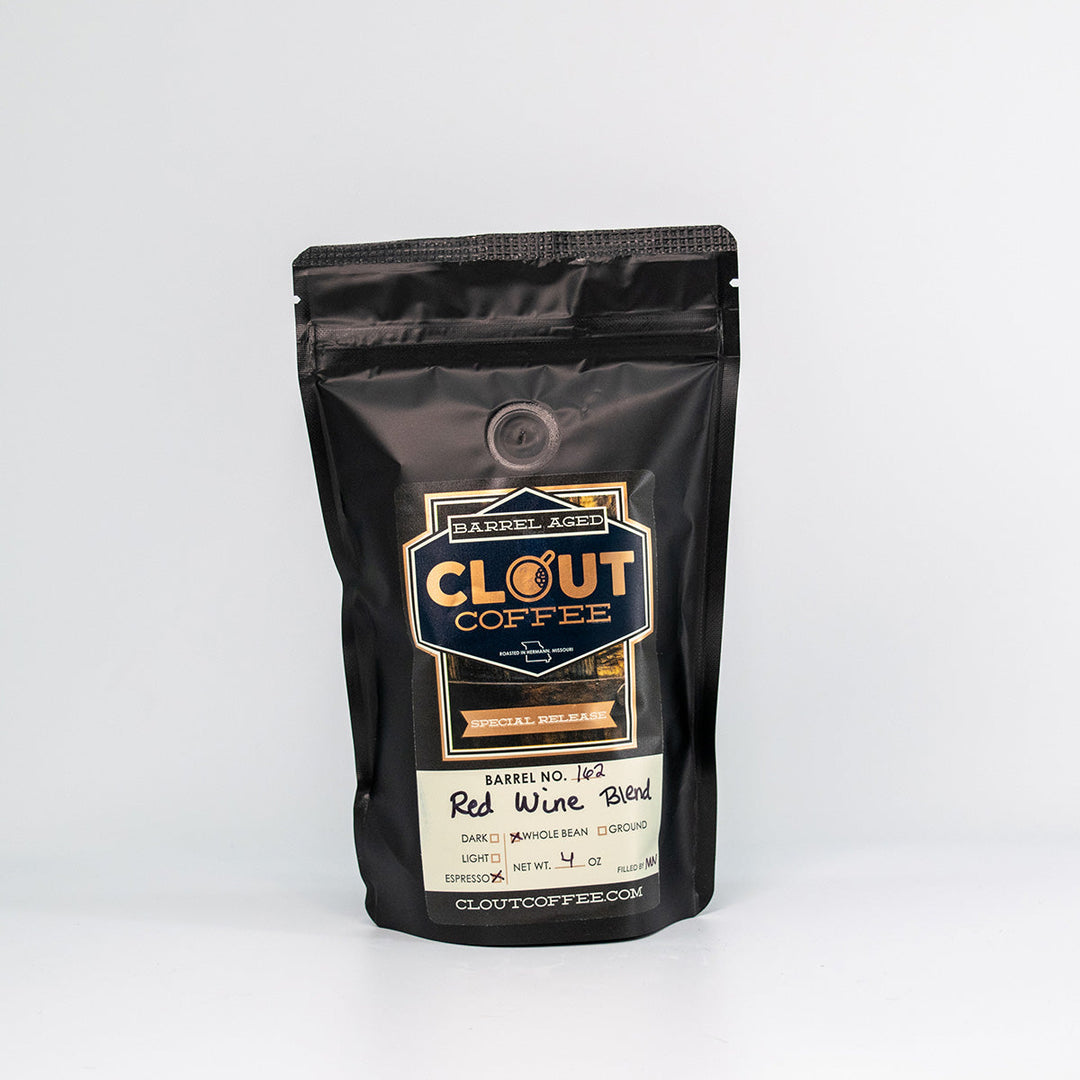
Clout Red Wine Barrel-Aged Coffee Sample 4 oz
- Green Coffee and Roasted Coffee does not qualify for free shipping. Shipping costs are set by our roaster partners. Coffee orders are shipped directly from the roaster partner.
- In stock, ready to ship
- Backordered, shipping soon
Clout Red Wine Barrel-Aged Coffee Sample 4 oz: Coffee Profile and Brewing Guide
This 4-ounce Clout Red Wine Barrel-Aged Coffee sample is a low-commitment introduction to coffee prepared in freshly emptied red wine barrels before roasting. Colombian Arabica provides the foundation, while barrel contact is intended to contribute dark-fruit aromatics, oak-like depth and a finish that recalls dry red wine. The sample size is useful for a focused tasting without committing to a full bag.
Coffee and wine are both evaluated through aroma, acidity, fruit character, fermentation and finish. Barrel resting brings those vocabularies together in a tangible way. Rather than treating this as a conventional flavored coffee, brew it beside a standard Colombian coffee and compare the dry fragrance, wet aroma, body and aftertaste. That side-by-side approach makes the barrel contribution easier to identify.
Coffee Details
| Origin or composition | Single-origin Colombian Arabica |
|---|---|
| Process or roast | Green coffee rested in freshly emptied red wine barrels before roasting |
| Tasting direction | Dark berries, oak and subtle wine-like tannin |
| Format | 4 oz sample |
Flavor, Acidity and Body
Expect a smooth, full-bodied cup with dark-berry notes, seasoned-oak character and a light tannin-like dryness in the finish. A clean filter extraction should separate the fruit and aromatic barrel notes, while immersion or concentrated brewing emphasizes body. Taste the coffee again as it cools, when berry-like acidity and wine-associated aromatics may become more distinct.
Brewing Recommendations
Use the small quantity deliberately. For pour-over, begin near a 1:16 brew ratio with a medium-fine grind, an even bloom and restrained agitation. For automatic drip, start near 60 grams per liter. French press around 1:15 will emphasize body and oak-like depth. Record dose, water weight, drawdown and taste so the second brew can target greater sweetness or clarity.
Dialing in the cup
- Record dry dose and water or beverage yield so the recipe can be repeated.
- Correct under-extraction with a slightly finer grind or more contact time.
- Correct bitterness or astringency with a coarser grind or lower extraction.
- Use drawdown and shot time as diagnostic feedback rather than fixed quality targets.
- Change one variable at a time and taste again as the coffee cools.
Who Should Choose This Coffee?
Choose this sample for a wine enthusiast, a coffee tasting flight or a first experiment with barrel-aged coffee. It is especially useful for comparing processing approaches without buying several full-size bags.
Format, Rest and Storage
The listing contains 4 ounces of roasted coffee. Select the available whole-bean or ground option that matches your brewer. Keep the sample sealed, cool and dry, and plan to use it across a few measured brews.
Equipment Pairings and Related Coffee
Browse more specialty coffee, compare home coffee grinders, or explore espresso machines.
Frequently Asked Questions
Explore coffee and equipment
Green Coffee and Roasted Coffee does not qualify for free shipping. Shipping costs are set by our roaster partners. Coffee orders are shipped directly from the roaster partner.