


Lelit Coffee Grinders: Complete Models and History
Lelit’s grinder catalog is smaller than its espresso-machine lineup, yet it spans two distinct ideas: the 64 mm flat-burr William for polished electronic dosing and the compact conical Fred family for simpler on-demand espresso. Used PL53, PL54 and earlier William variants make model numbers more reliable than marketing names.
Editorial disclosure: Espresso Outlet does not sell Lelit grinders. This independent guide explains the brand and compares its machines with supported alternatives in our catalog. Model availability, colors, suffixes, voltage and warranty terms vary by country. Information was reviewed in September 2026.
Lelit grinder guide: quick conclusions
- William PL72 is Lelit’s current flagship standalone grinder, built around 64 mm flat burrs, stepless adjustment and programmable timed doses.
- Fred PL043MMI and regional Fred Prima models provide compact stepless conical grinding; PL044 variants add timing features.
- PL53, PL54 and PL71 are important legacy references, but parts, voltage and electronics should be checked carefully.
- DF64 Gen 2 is the closest 64 mm single-dose comparison; Eureka Specialita more closely matches William’s timed hopper workflow.
Lelit history and place in coffee
Lelit began in Italy in 1986, producing domestic appliances and later specializing in prosumer espresso equipment. Its appeal grew from a combination of stainless construction, compact footprints and machine architectures that brought traditional Italian espresso controls into home kitchens.
The grinder line developed as a companion to those machines. Fred addressed buyers of compact single-boiler machines who needed genuine stepless espresso adjustment without a large commercial grinder. William moved higher with flat burrs, electronic controls and a design intended to sit beside Mara, Bianca and other premium Lelit machines.
Breville Group acquired Lelit in 2022. Lelit retained its identity and Italian espresso focus, but distribution and model availability still differ by country. The PL code remains essential: two listings called Fred can have different timers, controls or voltage, while William references can mean PL71 or PL72 generations.
Complete Lelit grinder model directory
This directory covers Lelit standalone grinders rather than built-in grinders inside combination appliances such as Kate. Regional finish and voltage suffixes are grouped under their mechanical platform.
| Model or family | Grinding system | Controls and workflow | Status and ideal user |
|---|---|---|---|
| William PL72 | 64 mm flat burrs | Stepless micrometric collar, LCD, programmable single/double doses and manual grinding | Current flagship; premium home espresso |
| Fred PL043MMI / Fred Prima | Conical burrs | Stepless micrometric adjustment and manual on-demand switch | Current/recent by region; compact espresso |
| Fred PL044MMT and timed Fred variants | Conical burrs | Stepless collar with timer-controlled dispensing | Regional/legacy; repeatable home espresso |
| PL53 | Conical burrs | Stepless collar, compact doserless delivery | Discontinued; budget used espresso |
| PL54 family | Flat-burr grinder platform | Doserless or timer variants depending on suffix | Discontinued; legacy home espresso |
| William PL71 | Flat burrs | Early William controls and on-demand dispensing | Superseded by PL72 |
| Kate integrated grinder | Integrated conical system | Built into the PL82 espresso machine | Not a standalone grinder |
William PL72
William PL72 uses a commercial-diameter flat-burr platform in a home-sized cabinet. Its display programs two timed doses, while manual mode supports purging or custom quantities. The portafilter fork and illuminated work area encourage direct grinding.
A timer does not measure grams, so owners should recalibrate buttons after changing beans or grind. The stepless collar offers espresso resolution but makes large moves to filter and exact returns less convenient than a numbered single-dose grinder.
Fred PL043MMI / Fred Prima
Fred is the simplest Lelit grinder concept: a small hopper, conical burrs and continuous adjustment. It is a natural visual and practical partner for Anna, Grace and Victoria-sized machines.
Manual grinding means the user stops the motor by switch or portafilter pressure and weighs the result separately. Its compactness is valuable, though grind speed and burr scale are below William.
Fred PL044MMT and timed Fred variants
PL044 adds timed convenience to the Fred platform. Exact controls differ across revisions, so sellers should not describe every PL044 with one generic feature list.
The timer simplifies repeated drinks, but retained grounds and bean changes alter output. Confirm the full suffix and manual before buying parts.
PL53
PL53 is an earlier compact Lelit grinder widely paired with entry machines. Its basic mechanical design can remain useful if burrs and adjustment threads are healthy.
Used examples need inspection for cracked hoppers, worn carriers and electrical compatibility. A low used price should be compared with the warranty and lower retention of a current SK40.
PL54 family
PL54 moved toward flat burrs and a larger cabinet. Multiple suffixes and market descriptions exist, so burr size, timer and dosing method should be verified from the rating plate and manual.
Electronics and proprietary plastic parts may be harder to find than burrs. It can still be a capable espresso grinder, but condition determines value.
William PL71
PL71 established William as the more refined Lelit grinder. The later PL72 is the safer reference for current specifications and support.
When shopping used, do not assume PL71 and PL72 control boards, burr carriers or displays interchange. Ask for a clear rating-plate photograph.
Kate integrated grinder
Kate combines espresso machine and grinder in one enclosure. It belongs in Lelit’s grinder history but cannot be evaluated as a standalone Fred or William replacement.
Service access, heat exposure and upgrade path differ from separate equipment. This guide excludes it from direct product comparisons.
How Lelit grinders work
William’s flat burrs shear coffee across opposing faces and generally grind faster than Fred’s smaller conical set. That does not make every William cup automatically superior; burr geometry, alignment, coffee and recipe decide the result. William’s key advantage is combining a larger burr platform with electronic on-demand convenience.
Both families use stepless adjustment. Continuous movement lets an espresso user make a very small correction, but there are no clicks to count. Mark settings before large moves and purge after adjustment. Turning coarser with the motor stopped is usually uncomplicated; moving much finer is safer while the grinder runs empty so beans cannot bind the carrier.
William and timed Fred models dose by elapsed motor time. Flow rate changes as grind size changes and as beans age. Program buttons only after dialing in, then check output weight daily or whenever the recipe changes.
Lelit grinders compared with Espresso Outlet alternatives
Lelit grinders are espresso-centered, so the strongest comparisons are not generic brew grinders. Match burr class and dosing workflow separately: William versus 64 mm single dose or electronic hopper grinders; Fred versus compact conical models.
| Lelit reference | Espresso Outlet alternative | Why it is comparable | Where it differs |
|---|---|---|---|
| William PL72 | Turin DF64 Gen 2 | 64 mm flat-burr home espresso | DF64 is low-retention single-dose with bellows, not an electronic hopper grinder. |
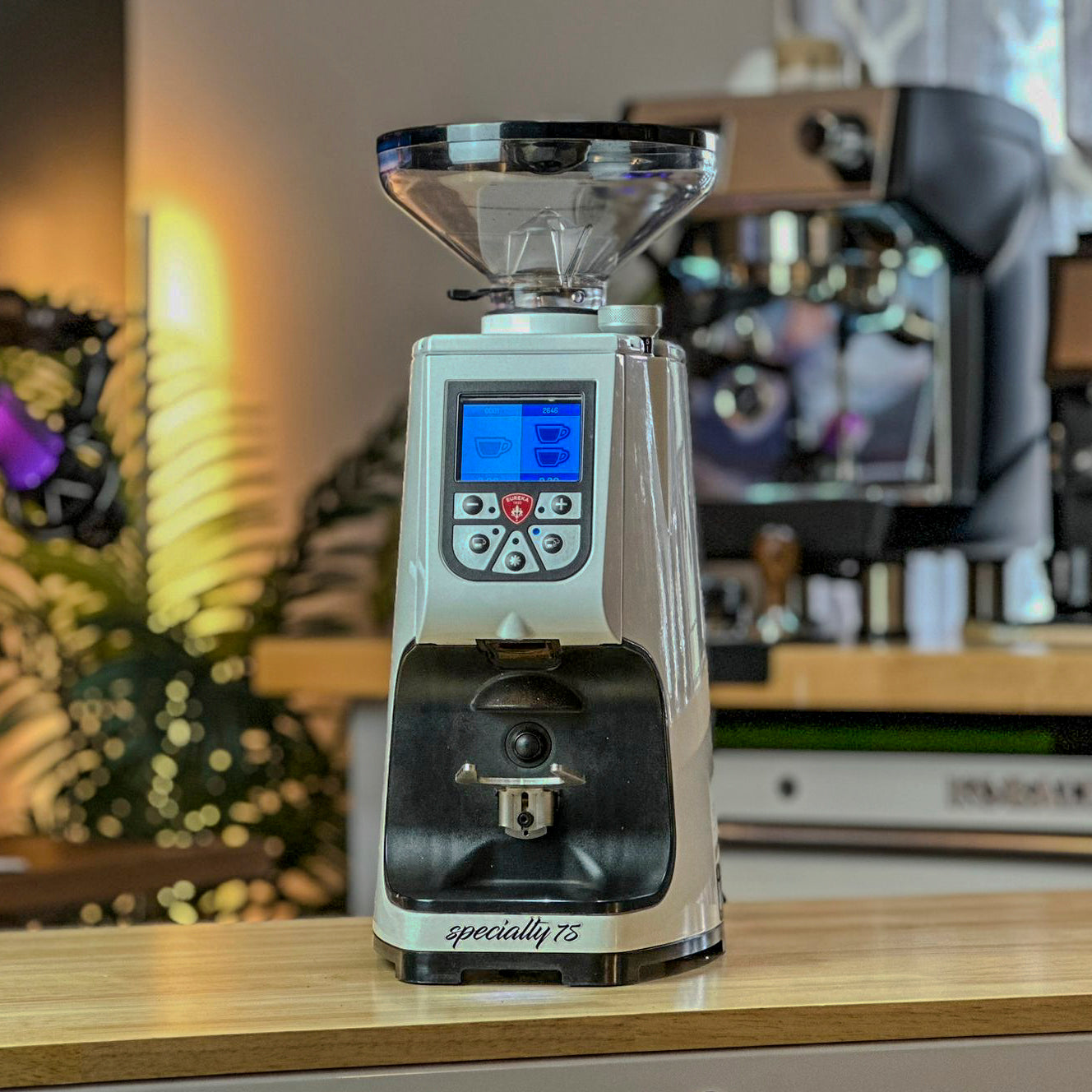
| William’s timed workflow | Eureka Mignon Specialita | Stepless flat burrs and programmable doses | Specialita uses 55 mm burrs and a very compact square cabinet. |
| Fred PL043/PL044 | Turin SK40 | Compact stepless conical espresso grinding | SK40 is designed around weighed single doses instead of a hopper timer. |
| Legacy PL53/PL54 replacement | Home grinder collection | Current supported espresso and multipurpose choices | New alternatives provide warranty, known voltage and easier consumable support. |
A matching Lelit pair is visually cohesive and convenient. Espresso Outlet alternatives become more compelling when low retention, frequent bean changes, burr ecosystem or a particular service path matters more than brand matching.
Which grinder should you choose?
For traditional espresso
William PL72 gives the finest Lelit combination of speed, adjustment and timed service. Fred can dial in espresso too, with slower output and simpler controls. DF64 Gen 2 suits experimenters; Specialita suits households making several drinks from the same hopper.
For filter coffee and immersion
Lelit’s standalone grinders are primarily designed for espresso. They can move coarser, but a full hopper, stepless unnumbered collar and retained coffee make daily switching awkward. A dedicated filter grinder or clearly marked single-dose platform is more practical.
For changing coffees and single dosing
Choose DF64 Gen 2 or SK40 if alternating regular and decaf is routine. Weigh beans before grinding and leave the hopper empty. William can be temporarily single-dosed, but its hopper and chute were designed around on-demand use and may retain more coffee.
For convenience and repeated drinks
William’s programmable buttons are the convenience winner in Lelit’s range. For a household using one espresso blend, dial in once, program single and double times, then verify dose as conditions change.
Dialing in: a practical method
Begin with the grinder clean, the burr carrier seated correctly and a known dose. For espresso, change only one variable at a time: hold dose and beverage yield constant, then move the grind setting in small increments. Purge enough coffee after an adjustment to clear retained grounds. If a shot runs fast, grind finer; if it chokes or runs very slowly, grind coarser. Taste still decides the final setting: a target time is a diagnostic starting point, not a guarantee of balanced extraction.
For pour-over or batch brewing, record coffee dose, water mass, brewer, filter, setting and total brew time. A muddy bed and slow drawdown can indicate excess fines; a very fast, weak cup may require a finer setting or more coffee. Burr condition, roast development, humidity and bean age all change how one numbered setting behaves. Numbers are references for one grinder, not universal particle-size measurements.
Retention, static, burrs and adjustment
Flat-burr on-demand grinders retain coffee in the chamber and chute by design. That retained coffee stabilizes flow during busy service but creates exchange when beans change. A short purge after an overnight rest or major adjustment improves consistency.
Fred’s smaller chamber may hold less total coffee, yet static and clumping depend on roast and humidity. Distribution in the basket remains necessary. Accessories such as dosing funnels can contain mess but cannot correct grind inconsistency.
A larger burr diameter does not automatically mean better coffee. Burr geometry influences how beans fracture and the balance of fines to larger particles; alignment determines whether the designed gap is consistent; motor and carrier rigidity influence behavior under load. Adjustment resolution matters greatly for unpressurized espresso because a tiny burr-gap change can alter flow. Filter brewing is more forgiving, though repeatability remains valuable.
Cleaning, maintenance and parts
Empty the hopper before burr access. Brush the upper and lower burr areas without losing calibration or cross-threading the carrier. Clean the chute and portafilter fork, then reassemble and approach the fine range gradually.
For William, keep the display and switches dry and avoid allowing packed coffee to harden behind the chute. For Fred, inspect the activation switch and adjustment threads. Use manufacturer-approved burrs and parts matched to the PL code.
Before opening any grinder, unplug it and follow its manual. Mark the current setting, remove beans, run or vacuum loose coffee as the manufacturer directs, and brush dry residue from accessible parts. Avoid water on steel burrs and never insert tools near a connected motor. After reassembly, confirm the burr carrier is seated and approach the fine end cautiously. A chirping burr touch is not a usable setting.
Buying used, imported or discontinued Lelit grinders
Ask a used seller for the full PL number, voltage label, running video and photographs of burrs, hopper and fork. On William, test the display and both dose buttons. On Fred, confirm the collar moves smoothly and does not have excessive play.
Commercial-looking burr size can distract from expensive electronics. A PL54 or PL71 with a failed board may not be economical. Compare the total cost of parts and shipping with a new supported grinder, not just the purchase price.
Voltage is not a cosmetic specification. A 230-volt, 50-hertz grinder should not be assumed compatible with a North American 120-volt circuit, and a plug adapter does not convert voltage or frequency. Confirm the rating plate, local warranty eligibility and availability of burrs, hoppers, carriers, switches, displays and control boards before importing or buying used.
Lelit grinder FAQs
Does Lelit still make William?
Yes. William PL72 remains Lelit’s principal standalone grinder in markets including the United States, though regional availability and suffixes differ.
What burrs are in William PL72?
Lelit specifies 64 mm flat burrs. Verify replacement-burr geometry and mounting pattern rather than purchasing solely by diameter.
Is William grind by weight?
No. Its programmable single and double doses are time based. Use a scale to establish and periodically verify the actual dose.
What is the difference between Fred PL043 and PL044?
PL043 versions are generally manual on-demand grinders, while PL044 references commonly add timed dosing. Exact suffixes and regional revisions matter.
Can Fred grind fine enough for espresso?
Yes. Fred is designed as a stepless espresso grinder. Its slower conical platform and simpler controls distinguish it from William, not an inability to grind fine.
Can William grind filter coffee?
It can move coarser, but its stepless espresso collar and hopper retention make frequent back-and-forth changes inconvenient. A single-dose all-purpose grinder is usually easier.
Is Kate’s grinder the same as Fred?
Kate contains an integrated grinder, but service, controls and installation differ. Do not assume parts or performance are identical without model-specific documentation.
Did Breville acquire Lelit?
Yes. Breville Group completed its acquisition of Lelit in 2022 while continuing the Lelit brand.
How often should Lelit burrs be replaced?
There is no universal calendar interval. Volume, roast and foreign objects matter. Replace when clean burrs show declining speed, inconsistent results or visible damage, using Lelit’s service guidance.
Should I buy William or DF64?
William is better for hopper-fed timed repetition and matching Lelit styling. DF64 is better for low-retention single dosing, switching beans and access to a broad 64 mm burr ecosystem.
Lelit buyer worksheet and ownership scenarios
A household that owns a Lelit Bianca and makes four milk drinks each morning from one espresso blend can use William exactly as intended: keep beans in the hopper, dial the stepless collar, program two timed doses and verify them with a scale. A household rotating small bags and decaf every day receives less value from the matching badge and more from DF64 Gen 2 single dosing. Fred suits the smaller station where manual control and slower conical grinding are acceptable.
Before buying used, demand the complete PL code and rating-plate photograph. On William, test every display segment, both programmed buttons, manual mode and the portafilter switch. Listen for a clean start and confirm that a small collar movement changes shot flow. On Fred, inspect the hopper, activation switch and adjustment threads. On PL54 and early William models, price a replacement control board before assuming a motor-running demonstration proves good value.
Ask the seller which burr is installed, approximately how much coffee it has ground, whether all fork and hopper parts are present and whether the unit was imported. A European plug adapter does not convert a 230-volt grinder for North American power. For new purchases, confirm that the dealer services the grinder line as well as Lelit espresso machines.
Final verdict
Lelit’s grinder hierarchy is coherent: Fred is the compact mechanical espresso partner, William PL72 is the faster 64 mm electronic flagship, and earlier PL grinders are condition-dependent used choices. The deciding question is workflow, not whether the logo matches the machine. A William is excellent for repeated doses; a DF64 or SK40 is more natural for single dosing.
For a supported alternative, browse home coffee grinders, compare commercial coffee grinders, or contact Espresso Outlet with your espresso machine, brew methods, expected daily volume and preferred workflow.
Official sources and further reading
- Lelit William PL72 — current specifications
- Lelit official site — current product catalog and company information
- Breville Group — Lelit acquisition information
- Espresso Outlet grinder collection — current comparison products
Last researched and reviewed: September 2026. Product lines can change; verify the exact regional model number before purchase.