


How Many Syrup Flavors Does a Coffee Shop
Coffee Business Resource Center
You do not need a wall of syrups to have an interesting coffee menu. You need flavors customers want, recipes the team can make consistently, and enough sales to use what you open.
For a new café or cart, a reasonable trial might be three familiar flavors and one rotating option. That is a starting experiment, not an industry rule. A business known for elaborate flavored drinks may support more; a small espresso bar may need fewer.
The useful question is what each bottle contributes to the business. Count the work, storage, waste, and customer appeal along with the sales.
Give each flavor a clear purpose
Start with customer requests and the drinks you intend to feature. A flavor can be a dependable everyday choice, an ingredient in several recipes, or the distinctive part of a signature drink. If two bottles serve nearly the same purpose, test whether customers care about the difference.
Keep a request tally instead of relying on the last conversation at the register. Record whether the person bought an alternative, left without purchasing, or asked about the flavor casually. Ten requests from ten likely customers mean more than ten suggestions from one regular who enjoys brainstorming.
A sugar-free option can serve a different customer need, but it still needs its own recipe, label information, and sales record. Do not assume two versions have identical sweetness, pump portions, ingredients, or storage instructions.
Calculate usable servings per bottle
Suppose a hypothetical syrup comes in a 750 mL bottle and your tested recipe uses 15 mL. The theoretical yield is fifty drinks. If you measure thirty milliliters left in the bottle and pump assembly that you cannot use, usable yield becomes forty-eight drinks.
At a $12 bottle cost, that is $0.25 per usable serving. If you sell only twenty-four servings before the product must be discarded under its applicable instructions and your handling plan, the syrup cost per sold serving becomes $0.50. The bottle price did not change; the amount you sold from it did.
Measure the actual portion your pump delivers. A pump count is only a usable recipe instruction when the team uses the specified pump, bottle, and complete stroke. Different dispensers and products can deliver different amounts. Do not use fluid volume and ingredient weight interchangeably without measuring the relationship.
Let storage instructions set the boundary
Write the opening date and applicable discard or quality-review information where staff can find it. Keep the original product identification. Follow the current label and manufacturer instructions for that product and dispenser, together with local food-handling requirements.
For example, Monin's US guidance distinguishes storage with a cap from storage with a pump or pour spout and identifies products that need refrigeration after opening. Its guidance should not be transferred to homemade syrup, another brand, or a different product line.
A bottle moving slowly is a reason to adjust purchasing or the menu. It is not a reason to extend its allowed use. Small bottle sizes, smaller orders, or a shorter seasonal offer may work better than buying the lowest price per liter.
Review a flavor as a small business decision
This illustrative review sheet gives each bottle a job and an action. Replace the descriptions with your own sales and waste records.
| Flavor role | What to measure | Likely decision if results are weak |
|---|---|---|
| Everyday favorite | Paid servings and repeat requests | Keep only the stock its demand supports |
| Ingredient used across recipes | Total use in all drinks, with portions counted | Consolidate recipes if overlap adds complexity |
| Seasonal feature | Incremental contribution and leftover stock | Shorten the run or reduce the next order |
| Occasional request | Actual purchases after requests | Test a smaller format before committing |
The AHLEI menu-engineering discussion evaluates popularity alongside contribution. For syrups, apply that idea to the drinks they help sell and the cost of unused stock; a bottle itself does not have a menu-item selling price.
Watch for apparent variety that creates hidden work
More flavors can mean longer order conversations, more chances to select the wrong bottle, additional purchasing lines, and harder stock counts. Put the most frequently used bottles in consistent positions and train a standard sequence for adding flavor.
Avoid turning every possible combination into a named menu item. You can offer a short list of clear signature drinks and a simple flavor modifier without asking customers to read dozens of almost identical descriptions.
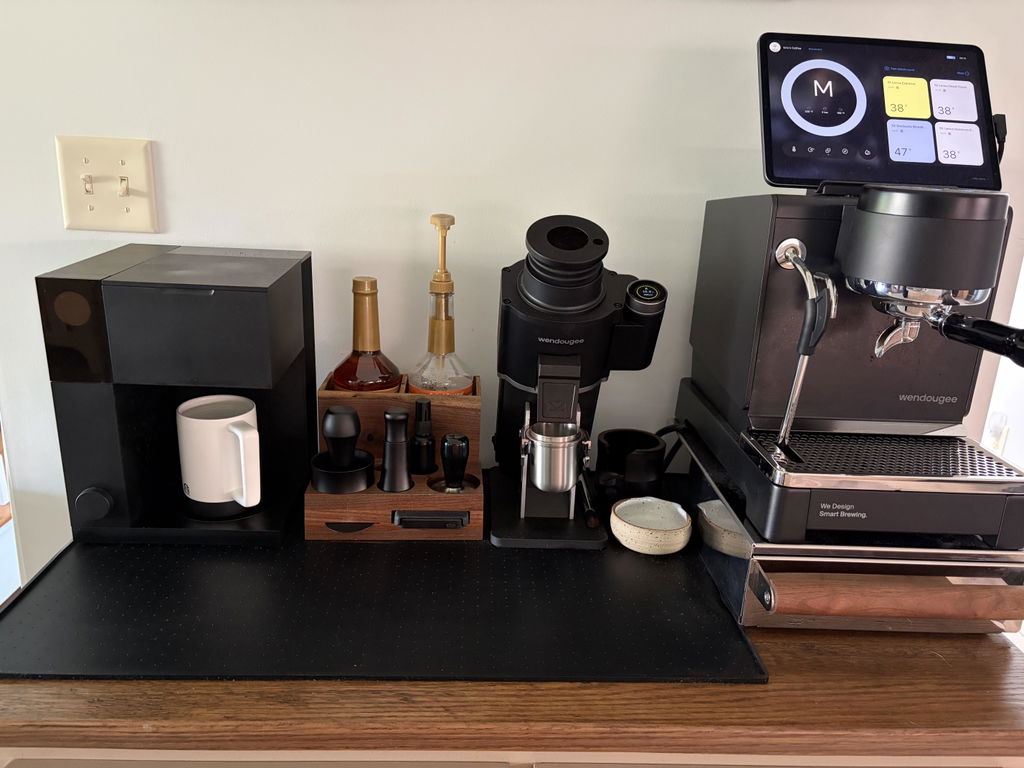
On a coffee cart, count the packed footprint of bottles, spare pumps, and reserve product. Check the working conditions too: a product stored beside a hot appliance or in direct summer sun may not be within its manufacturer's storage guidance. Choose a setup that protects the product throughout transport and service.
Introduce one flavor at a time
Give the trial a defined recipe, price, purchase quantity, and review date. Teach the team the taste and portion before putting it on the board. Use a dedicated register modifier so you can count demand accurately.
At the review, compare sales with the core drinks customers would otherwise have bought. A seasonal syrup might produce many orders by replacing an equally profitable vanilla latte; that is different from attracting additional purchases or improving contribution.
Ask staff whether it caused remakes or slowed a particular step. Listen to customer comments about sweetness and balance. A flavor that sells well but requires three extra actions may need a simpler recipe rather than immediate removal.
For more help connecting menu choices to the physical setup, explore the Coffee Business Resource Center. Bring your drink list to the equipment discussion; the bottles are only one part of the station they require.
Sources and further reading
- Monin US: product and storage FAQs — product-specific storage and dispenser distinctions.
- AHLEI: the power of menu engineering, part two — popularity and contribution as separate review measures.
Bottle prices, portions, losses, and trial sizes are hypothetical. Sources reviewed September 9, 2026.