Variable-Speed Coffee Grinders
Variable-speed grinders let you change burr RPM in addition to the grind setting. Speed can affect feeding, grinding time and the resulting particle distribution. It is a useful experimental control once your recipe is repeatable, but the lowest setting is not automatically the best.

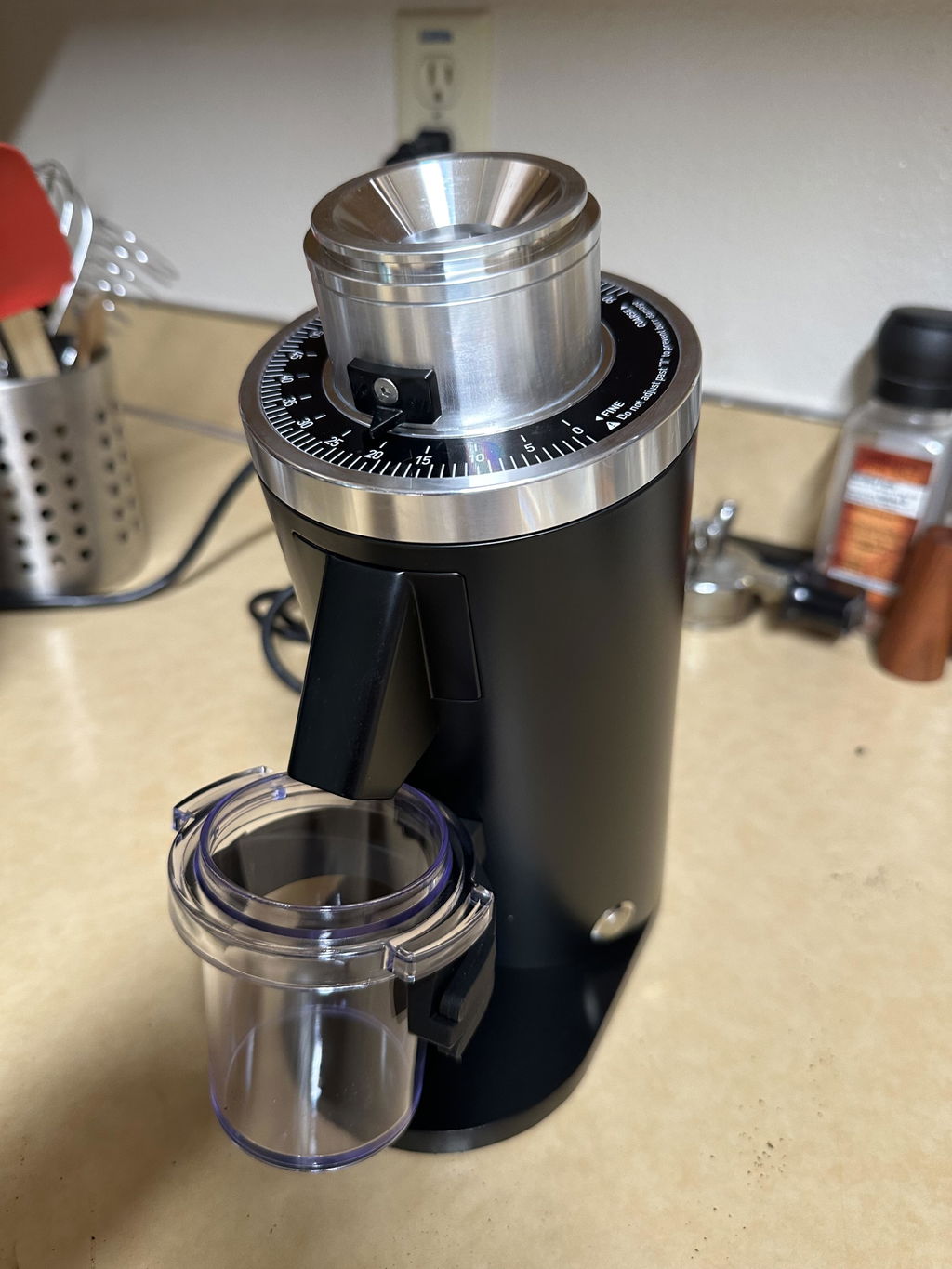
DF64V product photo from our website; check the current listing for the supplied generation and accessories.
RPM is not the same as grind size
Grind adjustment changes the working relationship between the burrs. RPM changes how quickly they rotate. A speed change can alter how coffee travels through the cutting surfaces, so the same dial position may no longer give the same brewing behavior.
Motor speed and burr speed are not necessarily identical in a geared system. Also, two different burr diameters have different edge speeds at the same RPM. Compare settings within one grinder before drawing conclusions across unrelated machines.
Start with the supported operating range
Follow the manufacturer’s range and startup instructions for your revision. The DF64V product guide distinguishes generations and explains its variable-speed workflow. A range quoted for an older model may not describe your unit.
Very low speed can change feeding or increase stalling risk in some conditions. If the grinder struggles, stop and follow its instructions rather than treating that as evidence that slower grinding is desirable.
Two useful experiments
- Fixed-setting test: keep grind position, dose, coffee and feeding method unchanged, vary only RPM and record grinding time and brewing behavior.
- Best-cup test: dial in separately at each speed, then compare the most successful repeatable recipe from each setting.
The first test asks what RPM changes mechanically in your setup. The second asks which complete recipe you prefer. They answer different questions. Do not claim one speed tastes better if it was simply the only one properly dialed in.
What to record
- Coffee, roast date and dose.
- Burr set, grind setting and RPM.
- Hot-start or other supported feeding method.
- Output mass and grinding time.
- Espresso yield and time, or filter recipe and drawdown.
- Taste observations from repeated cups.
Keep the beans at similar temperature and keep feeding consistent. Particle distribution can respond to conditions beyond speed. Slow feeding and slow rotation are also separate variables.
When RPM is worth adjusting
Experiment if you enjoy comparing texture and flavor presentation and have enough coffee to repeat the test. If your main issue is inconsistent dose or puck preparation, fix that first. Speed is not a substitute for an espresso-capable adjustment system or suitable burrs.
A fixed-speed grinder can still make excellent coffee. Choose variable speed for the control it gives you, not because a motor knob guarantees better extraction. See grinder motor types for the distinction between the control and the hardware.