


Spring Lever Espresso Machine Maintenance
Spring-lever espresso machines store significant energy in the group spring and operate with hot, pressurized water. Routine care should focus on safe cleaning, suitable water, inspection, and the exact manufacturer schedule—not generic pump-machine procedures.
First: identify the group and read its manual
A spring lever is not the same as a direct lever. Pulling a spring lever down fills the brew chamber and compresses a spring; releasing it lets the spring drive the piston. The group may be dipper-fed, pump-fed, or line-pressure-fed. Those differences determine how it is flushed, lubricated, drained, and serviced.
Record the model, serial number, voltage, group manufacturer, installation type, and water specification. Use the newest manual for that exact production revision.
Critical safety rules
- Keep your face and body out of the lever’s return path. Never release an unrestrained lever.
- Do not remove the portafilter until the lever has returned fully to its neutral position and group pressure has dissipated.
- If a shot is choked, do not force the lever back or unlock the portafilter under pressure.
- Before maintenance, switch off, unplug, close the water supply, allow the machine to cool, and confirm pressure gauges read zero.
- Do not disassemble the spring, piston, group, boiler, safety valve, pressurestat, or electrical system without the manufacturer procedure and appropriate training.
After every session
- Knock out the puck after the group has depressurized.
- Rinse the basket and portafilter, then wipe the basket rim and group gasket.
- Flush the group with plain water only as directed by the manual. Keep the portafilter removed unless the procedure explicitly calls for it.
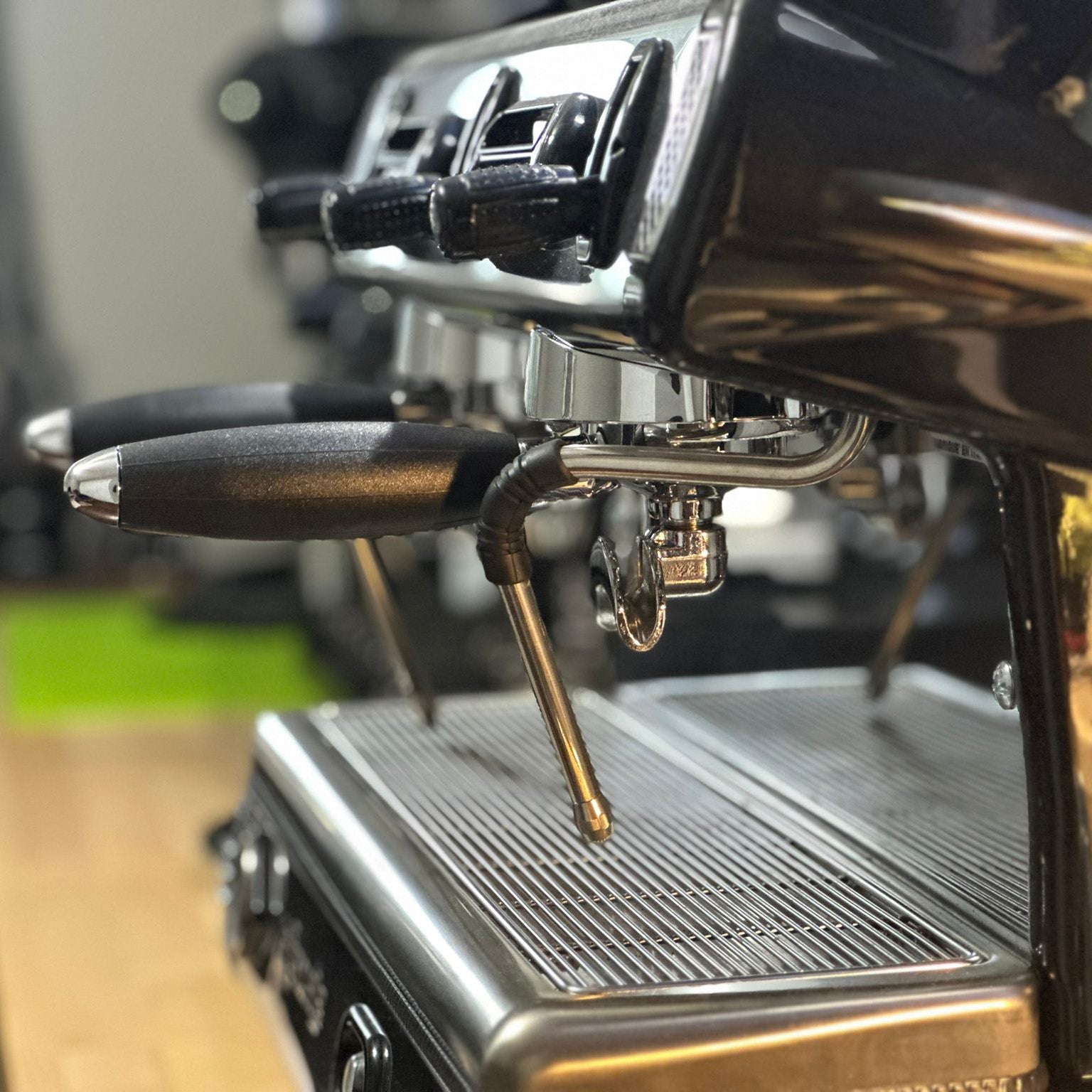
- Purge the steam wand before and immediately after milk use; wipe it with a clean damp cloth while avoiding the hot metal.
- Empty and rinse the drip tray and inspect the work area for leaks.
Do not assume the machine should be backflushed
Traditional spring groups generally do not have the pump-driven three-way exhaust system cleaned by conventional detergent backflushing. A blind basket can trap pressure and create an injury risk. Do not use a blind basket or backflush detergent unless the manual for the exact machine explicitly instructs it.
Weekly and monthly inspection
| Area | What to check | Response |
|---|---|---|
| Group and portafilter | Coffee buildup, damaged screen, gasket leakage | Clean with approved tools; replace only with the correct part |
| Lever movement | New stiffness, roughness, squeak or uneven return | Stop forcing it; arrange seal, cam or bearing inspection |
| Steam and hot-water valves | Drips, stiff controls, blocked tip holes | Clean the removable tip when cool; service worn valve parts |
| Boiler and plumbing | Leaks, corrosion, abnormal fill behavior | Switch off and obtain qualified service |
| Pressure and temperature | Changed boiler cycling or readings | Compare with the manual; do not adjust safety controls casually |
| Water treatment | Test result, filter capacity and replacement date | Service filtration from measured usage and specification |
Piston seals and lubrication
Piston seals are wear items, but there is no universal calendar interval. Leakage from the group, a dry or jerky lever, reduced fill, or altered return behavior can indicate inspection is due. Use only the seal orientation, lubricant, and procedure approved for the group. Too much grease can contaminate the shower screen; the wrong grease can damage seals or be unsuitable for food equipment.
Water and scale prevention
Hardness is only one part of espresso-machine water. Alkalinity, chloride, conductivity, pH, silica, and total dissolved solids can matter. Scale can obstruct fill paths and heat transfer, while overly aggressive water can corrode metal. Test the source and follow the machine maker’s limits.
Do not descale every three or six months by habit. Acid can loosen scale that blocks valves or damage finishes and seals. Profitec’s Pro 800 manual, for example, says an already calcified machine may require dealer descaling because partial boiler and tube disassembly can be necessary.
Long storage
- Follow the manufacturer’s shutdown and drain procedure; some boilers are not safely drained by simply opening a tap.
- Clean and dry removable coffee-contact parts.
- Close the plumbed water supply and protect the machine from freezing.
- Store the lever in the specified position and keep children away.
- After storage, inspect for pest damage, corrosion, stale water, leaks and hardened seals before heating.
When professional service is appropriate
Arrange service for spring work, recurring group leaks, electrical faults, boiler or safety-valve problems, scale removal, unexplained pressure changes, or any repair requiring the case or group to be opened. For equipment purchased from Espresso Outlet, begin with Espresso Outlet support and include the model, serial number, water information, photos, and a short video.
For model selection and architecture differences, continue to the spring lever buying guide.